Advertisements
Advertisements
प्रश्न
Mercury has an angle of contact equal to 140° with soda lime glass. A narrow tube of radius 1.00 mm made of this glass is dipped in a trough containing mercury. By what amount does the mercury dip down in the tube relative to the liquid surface outside? Surface tension of mercury at the temperature of the experiment is 0.465 N m–1. Density of mercury = 13.6 × 10³ kg m–3
Advertisements
उत्तर १
Angle of contact between mercury and soda lime glass, θ = 140°
Radius of the narrow tube, r = 1 mm = 1 × 10⁻³ m
Surface tension of mercury at the given temperature, s = 0.465 N m–1
Density of mercury, ρ =13.6 × 10³ kg/m3
Dip in the height of mercury = h
Acceleration due to gravity, g = 9.8 m/s2
Surface tension is related with the angle of contact and the dip in the height as:
`s = (hrhogr)/(2costheta)`
`:.h = (2s cos theta)/(rrhog)`
` = (2xx0.465xxcos 140)/(1xx10^(-3)xx13.6xx10^3xx 9.8)`
= - 0.00534 m
= -5.34 mm
Here, the negative sign shows the decreasing level of mercury. Hence, the mercury level dips by 5.34 mm
उत्तर २
Radius or tube = r = 1.00 mm = `10^(-3) m`
Surface tension of mercury, `sigma = 0.465 Nm^(-1)`
Density of mercury, `sigma = 13.6 xx 10^3 kg m6(-3)`
Angle of contact, `theta = 140^@`
`:. h = (2sigma cos theta)/(rrhog) = (2xx0.465xxcos 140^@)/(10^(-3)xx 13.6xx10^3xx 9.8)`
`= (2xx0.465xx(-0.7660))/(10^(-3)xx13.6xx10^3xx9.8)`
`= -5.34 xx 10^(-3) m = -5.34 mm`
Negative sign shows that the mercury level is deprssedin the tube
APPEARS IN
संबंधित प्रश्न
A raindrop of diameter 4 mm is about to fall on the ground. Calculate the pressure inside the raindrop. [Surface tension of water T = 0.072 N/m, atmospheric pressure = 1.013 x 10⁵ N/m2 ]
Explain why Surface tension of a liquid is independent of the area of the surface
A U-shaped wire is dipped in a soap solution and removed. The thin soap film formed between the wire and the light slider supports a weight of 1.5 × 10⁻² N (which includes the small weight of the slider). The length of the slider is 30 cm. What is the surface tension of the film?
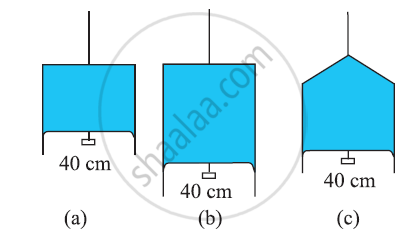
Figure (a) shows a thin liquid film supporting a small weight = 4.5 × 10⁻² N. What is the weight supported by a film of the same liquid at the same temperature in Fig. (b) and (c)? Explain your answer physically.
When water droplets merge to form a bigger drop
Find the excess pressure inside (a) a drop of mercury of radius 2 mm (b) a soap bubble of radius 4 mm and (c) an air bubble of radius 4 mm formed inside a tank of water. Surface tension of mercury, soap solution and water are 0.465 N m−1, 0.03 N m−1 and 0.076 N m−1 respectively.
A capillary tube of radius 0.50 mm is dipped vertically in a pot of water. Find the difference between the pressure of the water in the tube 5.0 cm below the surface and the atmospheric pressure. Surface tension of water = 0.075 N m−1.
A wire forming a loop is dipped into soap solution and taken out so that a film of soap solution is formed. A loop of 6.28 cm long thread is gently put on the film and the film is pricked with a needle inside the loop. The thread loop takes the shape of a circle. Find the tension the the thread. Surface tension of soap solution = 0.030 N m−1.
A ferry boat has internal volume 1 m3 and weight 50 kg.(a) Neglecting the thickness of the wood, find the fraction of the volume of the boat immersed in water.(b) If a leak develops in the bottom and water starts coming in, what fraction of the boat's volume will be filled with water before water starts coming in from the sides?
The water droplets are spherical in free fall due to ______
Mention the S.I unit and dimension of surface tension.
A square frame of each side L is dipped in a soap solution and taken out. The force acting on the film formed is _____.
(T = surface tension of soap solution).
Two spherical rain drops reach the surface of the earth with terminal velocities having ratio 16 : 9. The ratio of their surface area is ______.
The angle of contact at the interface of water-glass is 0°, Ethylalcohol-glass is 0°, Mercury-glass is 140° and Methyliodide-glass is 30°. A glass capillary is put in a trough containing one of these four liquids. It is observed that the meniscus is convex. The liquid in the trough is ______.
This model of the atmosphere works for relatively small distances. Identify the underlying assumption that limits the model.
A soap bubble of radius 3 cm is formed inside another soap bubble of radius 6 cm. The radius of an equivalent soap bubble which has the same excess pressure as inside the smaller bubble with respect to the atmospheric pressure is ______ cm.
In a U-tube, the radii of two columns are respectively r1 and r2. When a liquid of density ρ(θ = 0°) is filled in it, a level difference of h is observed on two arms, then the surface tension of the liquid is ______.
A liquid drop of density ρ is floating half immersed in a liquid of density d. The diameter of the liquid drop is ______.
(ρ > d, g = acceleration due to gravity, T = surface tension)
Work done to blow a bubble of volume V is W. The work done in blowing a bubble of volume 2V will be ______.
A drop of water of radius 8 mm breaks into number of droplets each of radius 1 mm. How many droplets will be formed?
