Advertisements
Advertisements
प्रश्न
The free surface of oil in a tanker, at rest, is horizontal. If the tanker starts accelerating the free surface will be titled by an angle θ. If the acceleration is a ms–2, what will be the slope of the free surface?
Advertisements
उत्तर
The behaviour of a liquid contained in a horizontally accelerated vessel can be understood by understanding the behaviour of a pendulum suspended from the ceiling of a horizontally accelerated trolley.
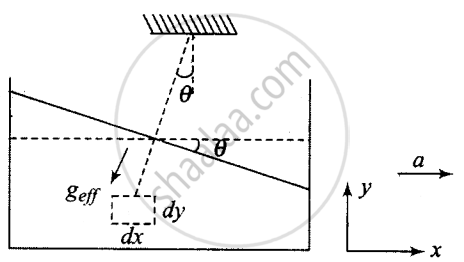
Every fluid element attains an equilibrium position under the action of gravity and pseudo-force. The free surface of the liquid orients itself perpendicular to the direction of net effective gravity.
tan θ = a/g
Suppose a tanker accelerates along the x-axis with acceleration a, the free surface of the tanker will not be horizontal because pseudo force acts as shown in the diagram.
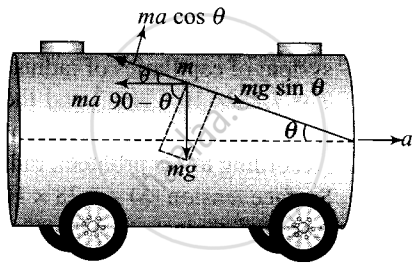
Consider an elementary particle of the oil of mass m.
The acting forces on the particle with respect to the tanker are shown in the figure alongside.
Now, balancing forces (as the particle is in equilibrium) along the inclined direction of the surface.
ma = pseudo force
mg = weight of small part of the oil.
Along the free surface,
Net force = 0
⇒ ma cos θ = mg sin θ
⇒ a = g tan θ
⇒ θ = tan-1(a/g)
APPEARS IN
संबंधित प्रश्न
Angle of contact for the pair of pure water with clean glass is _______.
A raindrop of diameter 4 mm is about to fall on the ground. Calculate the pressure inside the raindrop. [Surface tension of water T = 0.072 N/m, atmospheric pressure = 1.013 x 10⁵ N/m2 ]
Define the angle of contact.
The total energy of free surface of a liquid drop is 2π times the surface tension of the liquid. What is the diameter of the drop? (Assume all terms in SI unit).
When the size of a soap bubble is increased by pushing more air in it, the surface area increases. Does it mean that the average separation between the surface molecules is increased?
A heavy mass is attached to a thin wire and is whirled in a vertical circle. The wire is most likely to break
If two soap bubbles of different radii are connected by a tube,
The lower end of a capillary tube is immersed in mercury. The level of mercury in the tube is found to be 2 cm below the outer level. If the same tube is immersed in water, up to what height will the water rise in the capillary?
Find the force exerted by the water on a 2 m2 plane surface of a large stone placed at the bottom of a sea 500 m deep. Does the force depend on the orientation of the surface?
A ferry boat has internal volume 1 m3 and weight 50 kg.(a) Neglecting the thickness of the wood, find the fraction of the volume of the boat immersed in water.(b) If a leak develops in the bottom and water starts coming in, what fraction of the boat's volume will be filled with water before water starts coming in from the sides?
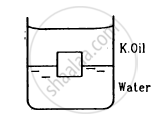
A cube of ice floats partly in water and partly in K.oil (in the following figure). Find the ratio of the volume of ice immersed in water to that in K.oil. Specific gravity of K.oil is 0.8 and that of ice is 0.9.
A drop of mercury of radius 0.2 cm is broken into 8 droplets of the same size. Find the work done if the surface tension of mercury is 435.5 dyn/cm.
Water rises to a height of 20 mm in a capillary tube. If the radius made 1/3rd of its previous value, to what height will the water now rise in the tube?
A drop of oil placed on the surface of water spreads out. But a drop of water place on oil contracts to a spherical shape. Why?
Two spherical rain drops reach the surface of the earth with terminal velocities having ratio 16 : 9. The ratio of their surface area is ______.
Water rises upto a height h in a capillary tube on the surface of the earth. The value of h will increase, if the experimental setup is kept in [g = acceleration due to gravity]
What is surface tension? Explain the applications of surface tension.
Is surface tension a vector?
A drop of water and a soap bubble have the same radii. Surface tension of soap solution is half of that of water. The ratio of excess pressure inside the drop and bubble is ______.
In a U-tube, the radii of two columns are respectively r1 and r2. When a liquid of density ρ(θ = 0°) is filled in it, a level difference of h is observed on two arms, then the surface tension of the liquid is ______.
