Advertisements
Advertisements
प्रश्न
Two mercury droplets of radii 0.1 cm. and 0.2 cm. collapse into one single drop. What amount of energy is released? The surface tension of mercury T = 435.5 × 10⁻³ Nm–1.
Advertisements
उत्तर
When two drops form a bigger drop, volume remains conserved.
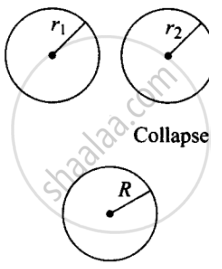
According to the problem, there is two mercury droplets of different radii collapse into one single drop.
Radius of smaller drop = r1 = 0.1 cm = 10–3 m
Radius of bigger drop = r2 = 0.2 cm = 2 × 10⁻³ m
Surface tension (T) = 435.5 × 10⁻³ N/m
Let V1 and V2 be the volumes of these two mercury droplets and the volume of big drops formed by collapsing is V.
The volume of a big drop = Volume of small droplets
`V = V_1 + V_2`
`4/3 πR^3 = 4/3 πr_1^3 + 4/3 πr_2^3`
or `R^3 = r_1^3 + r_2^3`
= (0.1)3 + (0.2)3
= 0.001 + 0.008
= 0.009
or R = 0.21 cm = 2 × 10⁻³ m
∴ Decrease in surface area,
ΔA = `4πR^2 - (4πr_1^2 + 4πr_2^2)`
= `4π[R^2 - (r_1^2 + r_2^2)]`
Energy released,
`E = T xx ΔA`
= `T xx 4π[R^2 - (r_1^2 + r_2^2)]`
= `435.5 xx 10^-3 xx 4 xx 3.14[(2.1 xx 10^-3)^2 - (1 xx 10^-6 + 4 xx 10^-6)]`
= `435.5 xx 4 xx 3.14[4.41 - 5] xx 10^-6 xx 10^-3`
= – 32.23 × 10⁻⁷ ......(Negative sign shows absorption)
Therefore, 3.22 × K–6 J energy will be absorbed. So, the surface area of the water decreases means the surface area of bigger drop is less than the sum of surface area of two smaller drops.
APPEARS IN
संबंधित प्रश्न
Angle of contact for the pair of pure water with clean glass is _______.
Draw a neat labelled diagram showing forces acting on the meniscus of water in a capillary tube.
In which of the following substances, surface tension increases with increase in temperature ?
- Copper
- Molten copper
- Iron
- Molten iron
The surface tension of water at 0ºc is 75·5 dyne/cm. Find surface tension of water at 25°C. [ α for water = 0·0021/°C ]
Explain why A drop of liquid under no external forces is always spherical in shape
A 20 cm long capillary tube is dipped in water. The water rises up to 8 cm. If the entire arrangement is put in a freely falling elevator, the length of water column in the capillary tube will be
A drop of mercury of radius 2 mm is split into 8 identical droplets. Find the increase in surface energy. Surface tension of mercury = 0.465 J m−2.
A cubical box is to be constructed with iron sheets 1 mm in thickness. What can be the minimum value of the external edge so that the cube does not sink in water? Density of iron = 8000 kg/m3 and density of water = 1000 kg/m3.
Derive an expression for capillary rise for a liquid having a concave meniscus.
Explain the phenomena of surface tension on the basis of molecular theory.
The property of _______ of a liquid surface enables the water droplets to move upward in plants.
How does surface tension help a plant?
A large number of liquid drops each of radius 'r' coalesce to form a big drop of radius 'R'. The energy released in the process in converted into kinetic energy of the big drop. The speed of the big drop is ______. (T = surface tension of liquid, p = density of liquid)
The sufrace tension and vapour pressure of water at 20°C is 7.28 × 10⁻² Nm–1 and 2.33 × 10³ Pa, respectively. What is the radius of the smallest spherical water droplet which can form without evaporating at 20°C?
Surface tension is exhibited by liquids due to force of attraction between molecules of the liquid. The surface tension decreases with increase in temperature and vanishes at boiling point. Given that the latent heat of vaporisation for water Lv = 540 k cal kg–1, the mechanical equivalent of heat J = 4.2 J cal–1, density of water ρw = 103 kg l–1, Avagadro’s No NA = 6.0 × 1026 k mole–1 and the molecular weight of water MA = 18 kg for 1 k mole.
- Estimate the energy required for one molecule of water to evaporate.
- Show that the inter–molecular distance for water is `d = [M_A/N_A xx 1/ρ_w]^(1/3)` and find its value.
- 1 g of water in the vapor state at 1 atm occupies 1601 cm3. Estimate the intermolecular distance at boiling point, in the vapour state.
- During vaporisation a molecule overcomes a force F, assumed constant, to go from an inter-molecular distance d to d ′. Estimate the value of F.
- Calculate F/d, which is a measure of the surface tension.
Two narrow bores of diameter 5.0 mm and 8.0 mm are joined together to form a U-shaped tube open at both ends. If this U-tube contains water, what is the difference in the level of the two limbs, of the tube?
[Take surface tension of water T = 7.3 × 10⁻² Nm-1, angle of contact = 0, g = 10 ms-2 and density of water = 1.0 × 10³ kgm-3]
In a U-tube, the radii of two columns are respectively r1 and r2. When a liquid of density ρ(θ = 0°) is filled in it, a level difference of h is observed on two arms, then the surface tension of the liquid is ______.
A liquid drop of density ρ is floating half immersed in a liquid of density d. The diameter of the liquid drop is ______.
(ρ > d, g = acceleration due to gravity, T = surface tension)
A drop of water of radius 8 mm breaks into number of droplets each of radius 1 mm. How many droplets will be formed?
