Advertisements
Advertisements
प्रश्न
If a drop of liquid breaks into smaller droplets, it results in lowering of temperature of the droplets. Let a drop of radius R, break into N small droplets each of radius r. Estimate the drop in temperature.
Advertisements
उत्तर
When a big drop of radius R, breaks into N droplets each of radius r, the volume remains constant.
∴ Volume of big drop = N × Volume of each small drop
`4/3 πR^3 = N xx 4/3 πR^3`
or `R^3 = Nr^3`
or `N = R^3/r^3`
Now, the change in surface area = `4πR^2 - N4πr^2`
= `4π(R^2 - Nr^2)`
The energy released = T × ΔA
= `S xx 4π(R^2 - Nr^2)` .....[T = Surface tension]
Due to releasing of this energy. the temperature is lowered.
If ρ is the density and s is the specific heat of liquid and its temperature is lowered by Δθ then the energy released = msΔθ ......[s = specific heat Δθ = change in temperature]
`T xx 4π(R^2 - Nr^2) = (4/3 xx R^3 xx ρ)sΔθ` ......`[∴m = vρ = 4/3 πR^3ρ]`
⇒ Δθ = `(T xx 4π(R^2 - Nr^2))/(4/3 πR^3 ρ xx s)`
= `(3T)/(ρs) [R^2/R^3 - (Nr^2)/R^3]`
= `(3T)/(ρs) [1/R - ((R^3-r^3) xx r^2)/R^3]`
= `(3T)/(ρs) [1/R - 1/r]`
APPEARS IN
संबंधित प्रश्न
The surface tension of water at 0°C is 75.5 dyne/cm. Calculate surface tension of water at 25°C.
(α for water = 2.7×10⁻³/°C)
'n' droplets of equal size of radius r coalesce to form a bigger drop of radius R. The energy liberated is equal to...................
(T =Surface tension of water)
`(a) 4piR^2T[n^(1/3)-1]`
`(b) 4pir^2T[n^(1/3)-1]`
`(c) 4piR^2T[n^(2/3)-1]`
`(d)4 pir^2T[n^(2/3)-1]`
Show that the surface tension of a liquid is numerically equal to the surface energy per unit
area.
When a sparingly soluble substance like alcohol is dissolved in water, surface tension of water
The contact angle between pure water and pure silver is 90°. If a capillary tube made of silver is dipped at one end in pure water, will the water rise in the capillary?
It is said that a liquid rises or is depressed in capillary due to the surface tension. If a liquid neither rises nor depresses in a capillary, can we conclude that the surface tension of the liquid is zero?
A uniform vertical tube of circular cross section contains a liquid. The contact angle is 90°. Consider a diameter of the tube lying in the surface of the liquid. The surface to the right of this diameter pulls the surface on the left of it. What keeps the surface on the left in equilibrium?
The force of surface tension acts tangentially to the surface whereas the force due to air pressure acts perpendicularly on the surface. How is then the force due to excess pressure inside a bubble balanced by the force due to the surface tension?
If water in one flask and castor oil in other are violently shaken and kept on a table, which will come to rest earlier?
The properties of a surface are different from those of the bulk liquid because the surface molecules
(a) are smaller than other molecules
(b) acquire charge due to collision from air molecules
(c) find different type of molecules in their range of influence
(d) feel a net force in one direction.
The capillaries shown in figure have inner radii 0.5 mm, 1.0 mm and 1.5 mm respectively. The liquid in the beaker is water. Find the heights of water level in the capillaries. The surface tension of water is 7.5 × 10⁻² N m−1.
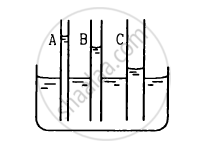
A barometer is constructed with its tube having radius 1.0 mm. Assume that the surface of mercury in the tube is spherical in shape. If the atmospheric pressure is equal to 76 cm of mercury, what will be the height raised in the barometer tube? The contact angle of mercury with glass = 135° and surface tension of mercury = 0.465 N m−1. Density of mercury = 13600 kg m−3.
Two large glass plates are placed vertically and parallel to each other inside a tank of water with separation between the plates equal to 1 mm. Find the rise of water in the space between the plates. Surface tension of water = 0.075 Nm−1.
Explain elasticity using intermolecular forces.
A square frame of each side L is dipped in a soap solution and taken out. The force acting on the film formed is _____.
(T = surface tension of soap solution).
If the surface tension of a soap solution is 3 × 10⁻² N/m then the work done in forming a soap film of 20 cm × 5 cm will be ______.
What is surface tension? Explain the applications of surface tension.
When an air bubble of radius r rises from the bottom to the surface of a lake, its radius becomes `(5r)/4`. Taking the atmospheric pressure to be equal to the 10 m height of the water column, the depth of the lake would approximately be ______.
(ignore the surface tension and the effect of temperature)
Define angle of contact.
