Advertisements
Advertisements
प्रश्न
The lower end of a capillary tube of radius 1 mm is dipped vertically into mercury. (a) Find the depression of mercury column in the capillary. (b) If the length dipped inside is half the answer of part (a), find the angle made by the mercury surface at the end of the capillary with the vertical. Surface tension of mercury = 0.465 N m−1 and the contact angle of mercury with glass −135 °.
Advertisements
उत्तर
Given:
Radius of tube r = 1 mm = 10−3 m
Contact angle of mercury with glass θ = 135°
Surface tension of mercury T = 0.465 N/m
Let ρ be the density of mercury.
(a) Depression (h) of mercury level is expressed as follows:
\[\text{ h } = \frac{2T\cos\theta}{r\rho g}\] ....(i)
\[\Rightarrow \text{ h } = \frac{2 \times 0 . 465 \times \cos 135^\circ }{{10}^{- 3} \times 13600 \times \left( 9 . 8 \right)}\]
\[ = 0 . 0053 \text{ m = 5 . 3 mm }\]
(b) If the length dipped inside is half the result obtained above:
New depression h'= \[\frac{h}{2}\]
Let the new contact angle of mercury with glass be θ'.
∴ \[h' = \frac{2T\cos\theta'}{r\rho g}\] ....(ii)
Dividing equation (ii) by (i), we get:
\[\frac{h'}{h} = \frac{\cos\theta'}{\cos\theta}\]
\[ \Rightarrow \cos\theta' = \frac{\cos\theta}{2}\]
\[\Rightarrow \theta = 112^\circ\]
APPEARS IN
संबंधित प्रश्न
Derive an expression for excess pressure inside a drop of liquid.
Explain why Water with detergent dissolved in it should have small angles of contact.
Fill in the blanks using the word(s) from the list appended with each statement
Surface tension of liquids generally . . . with temperatures (increases / decreases)
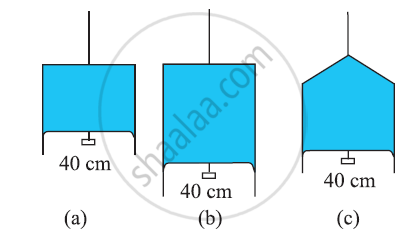
Figure (a) shows a thin liquid film supporting a small weight = 4.5 × 10⁻² N. What is the weight supported by a film of the same liquid at the same temperature in Fig. (b) and (c)? Explain your answer physically.
When a sparingly soluble substance like alcohol is dissolved in water, surface tension of water
By a surface of a liquid we mean
If two soap bubbles of different radii are connected by a tube,
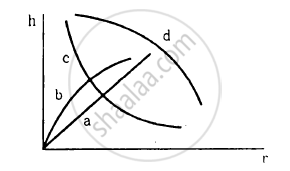
Which of the following graphs may represent the relation between the capillary rise hand the radius r of the capillary?
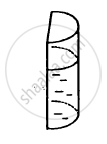
A liquid is contained in a vertical tube of semicircular cross section. The contact angle is zero. The force of surface tension on the curved part and on the flat part are in ratio
When a capillary tube is dipped into a liquid, the liquid neither rises nor falls in the capillary.
(a) The surface tension of the liquid must be zero.
(b) The contact angle must be 90°.
(c) The surface tension may be zero.
(d) The contact angle may be 90°.
A drop of mercury of radius 2 mm is split into 8 identical droplets. Find the increase in surface energy. Surface tension of mercury = 0.465 J m−2.
A wire forming a loop is dipped into soap solution and taken out so that a film of soap solution is formed. A loop of 6.28 cm long thread is gently put on the film and the film is pricked with a needle inside the loop. The thread loop takes the shape of a circle. Find the tension the the thread. Surface tension of soap solution = 0.030 N m−1.
A hollow spherical body of inner and outer radii 6 cm and 8 cm respectively floats half-submerged in water. Find the density of the material of the sphere.
Water rises to a height of 20 mm in a capillary tube. If the radius made 1/3rd of its previous value, to what height will the water now rise in the tube?
A u-tube is made up of capillaries of bore 1 mm and 2 mm respectively. The tube is held vertically and partially filled with a liquid of surface tension 49 dyne/cm and zero angles of contact. Calculate the density of the liquid, if the difference in the levels of the meniscus is 1.25 cm. take g = 980 cm/s2
Explain elasticity using intermolecular forces.
What are the factors affecting the surface tension of a liquid?
Surface tension is exhibited by liquids due to force of attraction between molecules of the liquid. The surface tension decreases with increase in temperature and vanishes at boiling point. Given that the latent heat of vaporisation for water Lv = 540 k cal kg–1, the mechanical equivalent of heat J = 4.2 J cal–1, density of water ρw = 103 kg l–1, Avagadro’s No NA = 6.0 × 1026 k mole–1 and the molecular weight of water MA = 18 kg for 1 k mole.
- Estimate the energy required for one molecule of water to evaporate.
- Show that the inter–molecular distance for water is `d = [M_A/N_A xx 1/ρ_w]^(1/3)` and find its value.
- 1 g of water in the vapor state at 1 atm occupies 1601 cm3. Estimate the intermolecular distance at boiling point, in the vapour state.
- During vaporisation a molecule overcomes a force F, assumed constant, to go from an inter-molecular distance d to d ′. Estimate the value of F.
- Calculate F/d, which is a measure of the surface tension.
A coaxial cylinder made of glass is immersed in liquid of surface tension ' S'. Radius of inner and outer surface of cylinder are R1 and R2 respectively. Height till which liquid will rise is (Density of liquid is p):
The surface tension of a soap solution is T. The work done in blowing a soap bubble of diameter d to that of a diameter 2d is ______.
