Advertisements
Advertisements
प्रश्न
The rise of a liquid in a capillary tube depends on
(a) the material
(b) the length
(c) the outer radius
(d) the inner radius of the tube
Advertisements
उत्तर
\[\text{ Height of the liquid in the capillary tube is given by }: \]
\[\text{ h } = \frac{2Scos\theta}{r\rho g}\]
\[\text{ h = Height }\]
\[\text{ S = Surface tension }\]
\[\text{ r = Inner radius of the tube }\]
\[\rho = \text{ Density of the liquid }\]
\[\text{ g = Acceleration due to gravity }\]
\[a) \theta \text{ and } \rho \text{ depend upon the material of the capillary tube and the liquid }. \]
\[b) \text{ h is dependent on the length of the tube . If the length is insufficient, then h will be low } . \]
\[d) \text{ r is the inner radius of the tube } .\]
APPEARS IN
संबंधित प्रश्न
Define surface tension and surface energy.
In a conical pendulum, a string of length 120 cm is fixed at rigid support and carries a mass
of 150 g at its free end. If the mass is revolved in a horizontal circle of radius 0.2 m around a
vertical axis, calculate tension in the string (g = 9.8 m/s2)
A body weighs 4.0 kg-wt on the surface of the Earth. What will be its weight on the surface of a plant whose mass is `1/8` th of the mass of the Earth and radius half `(1/2)` of that of the Earth?
Show that the surface tension of a liquid is numerically equal to the surface energy per unit
area.
The lower end of a capillary tube of radius 1 mm is dipped vertically into mercury. (a) Find the depression of mercury column in the capillary. (b) If the length dipped inside is half the answer of part (a), find the angle made by the mercury surface at the end of the capillary with the vertical. Surface tension of mercury = 0.465 N m−1 and the contact angle of mercury with glass −135 °.
A wire forming a loop is dipped into soap solution and taken out so that a film of soap solution is formed. A loop of 6.28 cm long thread is gently put on the film and the film is pricked with a needle inside the loop. The thread loop takes the shape of a circle. Find the tension the the thread. Surface tension of soap solution = 0.030 N m−1.
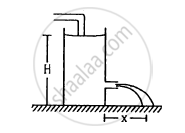
Water level is maintained in a cylindrical vessel up to a fixed height H. The vessel is kept on a horizontal plane. At what height above the bottom should a hole be made in the vessel so that the water stream coming out of the hole strikes the horizontal plane at the greatest distance from the vessel.
Twenty-seven droplets of water, each of radius 0.1 mm coalesce into a single drop. Find the change in surface energy. Surface tension of water is 0.072 N/m.
A drop of mercury of radius 0.2 cm is broken into 8 droplets of the same size. Find the work done if the surface tension of mercury is 435.5 dyn/cm.
Two soap bubbles have a radius in the ratio of 2:3. Compare the works done in blowing these bubbles.
A certain number of spherical drops of a liquid of radius R coalesce to form a single drop of radius R and volume V. If T is the surface tension of the liquid, then
What are the factors affecting the surface tension of a liquid?
Under isothermal conditions, two soap bubbles of radii 'r1' and 'r2' coalesce to form a big drop. The radius of the big drop is ______.
What is surface tension? Explain the applications of surface tension.
Why is raindrop spherical in nature?
Two narrow bores of diameter 5.0 mm and 8.0 mm are joined together to form a U-shaped tube open at both ends. If this U-tube contains water, what is the difference in the level of the two limbs, of the tube?
[Take surface tension of water T = 7.3 × 10⁻² Nm-1, angle of contact = 0, g = 10 ms-2 and density of water = 1.0 × 10³ kgm-3]
A soap bubble of radius 3 cm is formed inside another soap bubble of radius 6 cm. The radius of an equivalent soap bubble which has the same excess pressure as inside the smaller bubble with respect to the atmospheric pressure is ______ cm.
Two blocks of masses m and M are connected by means of a metal wire of cross-sectional area A passing over a frictionless fixed pully as shown in the figure. The system is then released. If M = 2m, then the stress produced in the wire is ______.

The surface tension of boiling water is ______.
