Advertisements
Advertisements
प्रश्न
Obtain an expression for the surface tension of a liquid by the capillary rise method.
Advertisements
उत्तर

Capillary rise by surface tension
Practical application of capillarity:
1. Due to capillary action, oil rises in the cotton within an earthen lamp. Likewise, sap raises from the roots of a plant to its leaves and branches.
2. Absorption of ink by blotting paper.
3. Capillary action is also essential for the tear fluid from the eye to drain constantly.
4. Cotton dresses are preferred in summer because cotton dresses have fine pores which act as capillaries for sweat.
Surface Tension by capillary rise method: The pressure difference across a curved liquid-air interface is the basic factor behind the rising up of water in a narrow tube (influence of gravity is ignored). The capillary rise is more dominant in the case of very fine tubes. But this phenomenon is the outcome of the force of surface tension. In order to arrive at a relation between the capillary rise (h) and surface tension (T), consider a capillary tube that is held vertically in a beaker containing water, the water rises in the capillary tube to a height of h due to surface tension.
The surface tension force FT, acts along the tangent at the point of contact downwards and its reaction force upwards. Surface tension T, it resolved into two components
(i) Horizontal component T sin θ and
(ii) Vertical component T cos θ acting upwards, all along the whole circumference of the meniscus Total upward force = (T cos θ) (2πr) = 2πrT cos θ
where θ is the angle of contact, r is the radius of the tube. Let ρ be the density of water and h be the height to which the liquid rises inside the tube. Then,
[the volume of liquid column in the tube, V] = [volume of the liquid column of radius r height h] + [volume of liquid of radius r and height r - Volume of the hemisphere of radius r]
V = `π"r"^2"h" + (π"r"^2 xx "r" - 2/3π"r"^3)`
V = `π"r"^2"h" + 1/3π"r"^3`
The upward force supports the weight of the liquid column above the free surface, therefore,
2πrT cos θ = `π"r"^2 ("h" + 1/3"r")ρ"g"`
T = `("r"("h" + 1/3"r")ρ"g")/(2 cos θ)`
If the capillary is a very fine tube of radius (i.e., the radius is very small) then `"r"/3` can be neglected when it is compared to the height h. Therefore,
T = `("r"ρ"gh")/(2 cos θ)`
Liquid rises through a height h
h = `(2 "T" cos θ)/("r"ρ"g") ⇒ "h" ∝ 1/"r"`
This implies that the capillary rise (h) is inversely proportional to the radius (r) of the tube, i. e., the smaller the radius of the tube greater will be the capillarity.
APPEARS IN
संबंधित प्रश्न
A U-shaped wire is dipped in a soap solution and removed. The thin soap film formed between the wire and the light slider supports a weight of 1.5 × 10⁻² N (which includes the small weight of the slider). The length of the slider is 30 cm. What is the surface tension of the film?
Calculate the work done in increasing the radius of a soap bubble in air from 1 cm to 2 cm. The surface tension of soap solution is 30 dyne/cm. (Π = 3.142).
A 20 cm long capillary tube is dipped in water. The water rises up to 8 cm. If the entire arrangement is put in a freely falling elevator, the length of water column in the capillary tube will be
Consider an ice cube of edge 1.0 cm kept in a gravity-free hall. Find the surface area of the water when the ice melts. Neglect the difference in densities of ice and water.
Two soap bubbles have a radius in the ratio of 2:3. Compare the works done in blowing these bubbles.
Explain the phenomena of surface tension on the basis of molecular theory.
Describe an experiment to prove that friction depends on the nature of a surface.
A spherical soap bubble A of radius 2 cm is formed inside another bubble B of radius 4 cm. Show that the radius of a single soap bubble which maintains the same pressure difference as inside the smaller and outside the larger soap bubble is lesser than the radius of both soap bubbles A and B.
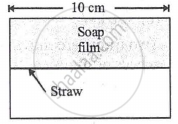
A soap film of surface tension 3 × 10⁻² formed in a rectangular frame can support a straw as shown in Fig. If g = 10 ms-12, the mass of the straw is ______.
The surface tension of a soap solution is T. The work done in blowing a soap bubble of diameter d to that of a diameter 2d is ______.
