Advertisements
Advertisements
प्रश्न
An ice cube is suspended in vacuum in a gravity free hall. As the ice melts it
पर्याय
will retain its cubical shape
will change its shape to spherical
will fall down on the floor of the hall
will fly up.
Advertisements
उत्तर
As the ice cube melts completely, the water thus formed will have minimum surface area due to its surface tension. Any state of matter that has a minimum surface area to its volume takes the shape of a sphere. Therefore, as the ice melts, it will take the shape of a sphere.
APPEARS IN
संबंधित प्रश्न
Derive Laplace’s law for spherical membrane of bubble due to surface tension.
Define the angle of contact.
State any two characteristics of the angle of contact
When a sparingly soluble substance like alcohol is dissolved in water, surface tension of water
Water near the bed of a deep river is quiet while that near the surface flows. Give reasons.
If more air is pushed in a soap bubble, the pressure in it
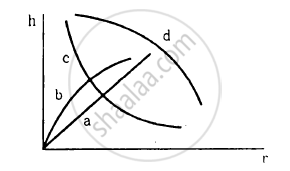
Which of the following graphs may represent the relation between the capillary rise hand the radius r of the capillary?
Find the surface energy of water kept in a cylindrical vessel of radius 6.0 cm. Surface tension of water = 0.075 J m−2.
Solve the previous problem if the lead piece is fastened on the top surface of the block and the block is to float with its upper surface just dipping into water.
A cubical metal block of edge 12 cm floats in mercury with one fifth of the height inside the mercury. Water in it. Find the height of the water column to be poured.
Specific gravity of mercury = 13.6.
Why is the surface tension of paints and lubricating oils kept low?
Derive an expression for capillary rise for a liquid having a concave meniscus.
What will be the shape of the liquid meniscus for the obtuse angle of contact?
Water rises to a height of 20 mm in a capillary tube. If the radius made 1/3rd of its previous value, to what height will the water now rise in the tube?
A drop of oil placed on the surface of water spreads out. But a drop of water place on oil contracts to a spherical shape. Why?
The surface tension of the two liquids is respectively 20 and 60 dyne cm-1. The liquids drop from the ends of two tubes of the same radius. The ratio of the weights of the two drops is ______
Two spherical rain drops reach the surface of the earth with terminal velocities having ratio 16 : 9. The ratio of their surface area is ______.
A water drop of radius R' splits into 'n' smaller drops, each of radius 'r'. The work done in the process is ______.
T = surface tension of water
What is surface tension? Explain the applications of surface tension.
The length of a needle floating on water is 2 cm. The additional force due to surface tension required to pull the needle out of water will be (S.T. of water = 7.0 × 10⁻² N/m).
