Advertisements
Advertisements
प्रश्न
What is the excess pressure inside a bubble of soap solution of radius 5.00 mm, given that the surface tension of soap solution at the temperature (20 °C) is 2.50 × 10⁻² N m–1? If an air bubble of the same dimension were formed at depth of 40.0 cm inside a container containing the soap solution (of relative density 1.20), what would be the pressure inside the bubble? (1 atmospheric pressure is 1.01 × 10⁵ Pa).
Advertisements
उत्तर १
Here surface tension of soap solution at room temperature
T = 2.50 x 10⁻² Nm-1, radius of soap bubble, r = 5.00 mm = 5.00 x 10⁻³ m.
:. Excess pressure inside soap bubble, `p = p_i - p_0 = (4T)/r`
`= (4xx2.50xx10^(-2))/(5.00xx10^(-3)) = 20.0 Pa`
When an air bubble of radius `r = 5.00 xx 10^(-3)` m is formed at a depth h = 40.0 cm = 0.4 m inside a container containing a soap solution of relative density 1.20 or density `rho = 1.20 xx 10^3 kg m^(-3)`, then excess pressure
`P = P_i - P_0 = (2T)/r`
`:. P_i = P_0 + (2T)/r = (P_a + hrhog) + (2T)/r`
`=[1.01 xx 10^5 + 0.4 xx 1.2 xx 10^3 xx 9.8 + (2xx2.50xx10^(-2))/(5.00xx10^(-3))] Pa`
`= (1.01 xx 10^5 + 4.7 xx 10^3 + 10.0)Pa`
`= 1.06 xx 10^5` Pa
उत्तर २
Excess pressure inside the soap bubble is 20 Pa;
Pressure inside the air bubble is `1.06 xx 10^5 Pa`
Soap bubble is of radius, r = 5.00 mm = 5 × 10⁻³ m
Surface tension of the soap solution, S = 2.50 × 10⁻² Nm–1
Relative density of the soap solution = 1.20
∴Density of the soap solution, ρ = 1.2 × 10³ kg/m3
Air bubble formed at a depth, h = 40 cm = 0.4 m
Radius of the air bubble, r = 5 mm = 5 × 10⁻³ m
1 atmospheric pressure = 1.01 × 10⁵ Pa
Acceleration due to gravity, g = 9.8 m/s2
Hence, the excess pressure inside the soap bubble is given by the relation:
`P = 4S/r`
`= (4xx2.5xx10^(-2))/(5xx10^(-3))`
= 20 Pa
Therefore, the excess pressure inside the soap bubble is 20 Pa.
The excess pressure inside the air bubble is given by the relation:
`P = (2S)/r`
`= (2xx2.5xx10^(-2))/(5xx10^(-3))`
= 10 Pa
Therefore, the excess pressure inside the air bubble is 10 Pa.
At a depth of 0.4 m, the total pressure inside the air bubble
= Atmospheric pressure + hρg + P’
`= 1.01 xx 10^5 +0.4 xx 1.2 xx 10^3 xx 9.8 + 10`
`= 1.057 xx 10^5 Pa`
`= 1.06 xx 10^(5) Pa`
Therefore, the pressure inside the air bubble is `1.06 xx 10^5 Pa`
APPEARS IN
संबंधित प्रश्न
The energy of the free surface of a liquid drop is 5π times the surface tension of the liquid. Find the diameter of the drop in C.G.S. system.
Derive Laplace’s law for spherical membrane of bubble due to surface tension.
Define the angle of contact.
Explain why A drop of liquid under no external forces is always spherical in shape
The total energy of free surface of a liquid drop is 2π times the surface tension of the liquid. What is the diameter of the drop? (Assume all terms in SI unit).
A body weighs 4.0 kg-wt on the surface of the Earth. What will be its weight on the surface of a plant whose mass is `1/8` th of the mass of the Earth and radius half `(1/2)` of that of the Earth?
Calculate the work done in increasing the radius of a soap bubble in air from 1 cm to 2 cm. The surface tension of soap solution is 30 dyne/cm. (Π = 3.142).
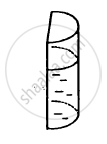
A liquid is contained in a vertical tube of semicircular cross section. The contact angle is zero. The force of surface tension on the curved part and on the flat part are in ratio
The energy stored in a soap bubble of diameter 6 cm and T = 0.04 N/m is nearly ______.
Obtain an expression for the capillary rise or fall using the forces method.
How does surface tension help a plant?
Explain elasticity using intermolecular forces.
Define the angle of contact for a given pair of solid and liquid.
A square frame of each side L is dipped in a soap solution and taken out. The force acting on the film formed is _____.
(T = surface tension of soap solution).
A water drop of radius R' splits into 'n' smaller drops, each of radius 'r'. The work done in the process is ______.
T = surface tension of water
Soap solution is used for cleaning dirty clothes because ______.
Two mercury droplets of radii 0.1 cm. and 0.2 cm. collapse into one single drop. What amount of energy is released? The surface tension of mercury T = 435.5 × 10⁻³ Nm–1.
The sufrace tension and vapour pressure of water at 20°C is 7.28 × 10⁻² Nm–1 and 2.33 × 10³ Pa, respectively. What is the radius of the smallest spherical water droplet which can form without evaporating at 20°C?
Work done to blow a bubble of volume V is W. The work done in blowing a bubble of volume 2V will be ______.
The surface tension of boiling water is ______.
