Advertisements
Advertisements
प्रश्न
Air is pushed into a soap bubble of radius r to double its radius. If the surface tension of the soap solution in S, the work done in the process is
पर्याय
8 π r2 S
12 π r2 S
16 π r2 S
24 π r2 S
Advertisements
उत्तर
\[\text{ No . of surfaces of a soap bubble } = 2\]
\[\text{ Increase in surface area }= 4\pi(2r )^2 - 4\pi(r )^2 = 12 \pi r^2 \]
\[\text{ Total increase in surface area }= 2 \times 12 \pi r^2 = 24 \pi r^2 \]
\[\text{ Work done = change in surface energy } \]
\[ = S \times 24 \pi r^2 = 24 \pi r^2 S\]
APPEARS IN
संबंधित प्रश्न
Draw a neat labelled diagram showing forces acting on the meniscus of water in a capillary tube.
Explain why Water with detergent dissolved in it should have small angles of contact.
A U-shaped wire is dipped in a soap solution and removed. The thin soap film formed between the wire and the light slider supports a weight of 1.5 × 10⁻² N (which includes the small weight of the slider). The length of the slider is 30 cm. What is the surface tension of the film?
Mercury has an angle of contact equal to 140° with soda lime glass. A narrow tube of radius 1.00 mm made of this glass is dipped in a trough containing mercury. By what amount does the mercury dip down in the tube relative to the liquid surface outside? Surface tension of mercury at the temperature of the experiment is 0.465 N m–1. Density of mercury = 13.6 × 10³ kg m–3
In a conical pendulum, a string of length 120 cm is fixed at rigid support and carries a mass
of 150 g at its free end. If the mass is revolved in a horizontal circle of radius 0.2 m around a
vertical axis, calculate tension in the string (g = 9.8 m/s2)
When a glass capillary tube is dipped at one end in water, water rises in the tube. The gravitational potential energy is thus increased. Is it a violation of conservation of energy?
Water rises in a vertical capillary tube up to a length of 10 cm. If the tube is inclined at 45°, the length of water risen in the tube will be
A solid sphere of radius 5 cm floats in water. If a maximum load of 0.1 kg can be put on it without wetting the load, find the specific gravity of the material of the sphere.
Explain the capillary action.
Twenty-seven droplets of water, each of radius 0.1 mm coalesce into a single drop. Find the change in surface energy. Surface tension of water is 0.072 N/m.
Explain the phenomena of surface tension on the basis of molecular theory.
Obtain an expression for the capillary rise or fall using the forces method.
The property of _______ of a liquid surface enables the water droplets to move upward in plants.
How is surface tension related to surface energy?
What is capillarity?
A water drop of radius R' splits into 'n' smaller drops, each of radius 'r'. The work done in the process is ______.
T = surface tension of water
The sap in trees, which consists mainly of water in summer, rises in a system of capillaries of radius r = 2.5 × 10⁻⁵ m. The surface tension of sap is T = 7.28 × 10⁻² Nm–1 and the angle of contact is 0°. Does surface tension alone account for the supply of water to the top of all trees?
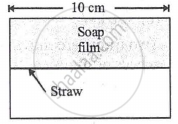
A soap film of surface tension 3 × 10⁻² formed in a rectangular frame can support a straw as shown in Fig. If g = 10 ms-12, the mass of the straw is ______.