Advertisements
Advertisements
प्रश्न
A cubical metal block of edge 12 cm floats in mercury with one fifth of the height inside the mercury. Water in it. Find the height of the water column to be poured.
Specific gravity of mercury = 13.6.
Advertisements
उत्तर
Given:
Length of the edge of the metal block, x = 12 cm
Specific gravity of mercury, \[\rho_{Hg}\]= 13.6 gm/cc
It is given that`1/5`th of the cubical block is inside mercury initially.
Let `rho_b` be the density of the block in gm/cc.
\[\therefore (\text{ x } )^3 \times \rho_\text{ b } \times \text{ g } = (\text{ x } )^2 \times \left( \frac{\text{x}}{5} \right) \times \rho_{Hg} \times \text{g}\]
\[ \Rightarrow (12 )^3 \times \rho_\text{b} \times \text{g} = (12 )^2 \times \frac{12}{5} \times 13 . 6\]
\[ \Rightarrow \rho_\text{ b } = \frac{13 . 6}{5} \text{ gm/cc }\]
Let y be the height of the water column after the water is poured.
∴ Vb = VHg + Vw = (12)3
Here,
VHg = Volume of the block inside mercury
Vw = Volume of the block inside water
\[\therefore ( \text {V}_\text{b} \times \rho_\text{b} \times \text{g}) = ( \text{V}_{\text{Hg}} \times \rho_{\text{Hg}} \times \text{g}) + ( \text{V}_\text{w} \times \rho_\text{w} \times \text{g})\]
\[ \Rightarrow ( \text{V}_{\text{Hg}} + \text{V}_\text{w} ) \times \frac{13 . 6}{5} = \text{V}_{\text{Hg}} \times 13 . 6 + \text{V}_\text{w} \times 1\]
\[ \Rightarrow (12 )^3 \times \frac{13 . 6}{5} = (12 - \text{y}) \times (12 )^2 \times 13 . 6 + (\text{y}) \times (12 )^2 \times 1\]
\[ \Rightarrow 12 \times \frac{13 . 6}{5} = (12 -\text{ y}) \times 13 . 6 + (\text{y})\]
\[ \Rightarrow 12 . 6\text{y }= 13 . 6\left( 12 - \frac{12}{5} \right) = (13 . 6) \times (9 . 6)\]
\[ \Rightarrow \text{y} = \frac{(9 . 6) \times (13 . 6)}{(12 . 6)} = 10 . 4 \text{cm}\]
APPEARS IN
संबंधित प्रश्न
The surface tension of water at 0°C is 75.5 dyne/cm. Calculate surface tension of water at 25°C.
(α for water = 2.7×10⁻³/°C)
The surface tension of water at 0ºc is 75·5 dyne/cm. Find surface tension of water at 25°C. [ α for water = 0·0021/°C ]
Mercury has an angle of contact equal to 140° with soda lime glass. A narrow tube of radius 1.00 mm made of this glass is dipped in a trough containing mercury. By what amount does the mercury dip down in the tube relative to the liquid surface outside? Surface tension of mercury at the temperature of the experiment is 0.465 N m–1. Density of mercury = 13.6 × 10³ kg m–3
Two narrow bores of diameters 3.0 mm and 6.0 mm are joined together to form a U-tube open at both ends. If the U-tube contains water, what is the difference in its levels in the two limbs of the tube? Surface tension of water at the temperature of the experiment is 7.3 × 10⁻² N m–1. Take the angle of contact to be zero and density of water to be 1.0 × 10³ kg m–3 (g = 9.8 m s–2)
A body weighs 4.0 kg-wt on the surface of the Earth. What will be its weight on the surface of a plant whose mass is `1/8` th of the mass of the Earth and radius half `(1/2)` of that of the Earth?
When a sparingly soluble substance like alcohol is dissolved in water, surface tension of water
Water rises in a vertical capillary tube up to a length of 10 cm. If the tube is inclined at 45°, the length of water risen in the tube will be
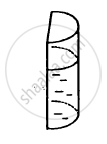
A liquid is contained in a vertical tube of semicircular cross section. The contact angle is zero. The force of surface tension on the curved part and on the flat part are in ratio
A solid sphere of radius 5 cm floats in water. If a maximum load of 0.1 kg can be put on it without wetting the load, find the specific gravity of the material of the sphere.
Calculate the rise of water inside a clean glass capillary tube of radius 0.1 mm, when immersed in water of surface tension 7 × 10⁻² N/m. The angle of contact between water and glass is zero, the density of water = 1000 kg/m3, g = 9.8 m/s2.
A u-tube is made up of capillaries of bore 1 mm and 2 mm respectively. The tube is held vertically and partially filled with a liquid of surface tension 49 dyne/cm and zero angles of contact. Calculate the density of the liquid, if the difference in the levels of the meniscus is 1.25 cm. take g = 980 cm/s2
Numerical Problem.
A stone weighs 500 N. Calculate the pressure exerted by it if it makes contact with a surface of area 25 cm2.
The surface tension of the two liquids is respectively 20 and 60 dyne cm-1. The liquids drop from the ends of two tubes of the same radius. The ratio of the weights of the two drops is ______
Two spherical rain drops reach the surface of the earth with terminal velocities having ratio 16 : 9. The ratio of their surface area is ______.
A water drop of radius R' splits into 'n' smaller drops, each of radius 'r'. The work done in the process is ______.
T = surface tension of water
What is surface tension? Explain the applications of surface tension.
A hot air balloon is a sphere of radius 8 m. The air inside is at a temperature of 60°C. How large a mass can the balloon lift when the outside temperature is 20°C? (Assume air is an ideal gas, R = 8.314 J mole–1K–1, 1 atm. = 1.013 × 10⁵ Pa; the membrane tension is 5 Nm–1.)
A soap bubble of radius 3 cm is formed inside another soap bubble of radius 6 cm. The radius of an equivalent soap bubble which has the same excess pressure as inside the smaller bubble with respect to the atmospheric pressure is ______ cm.
A drop of water and a soap bubble have the same radii. Surface tension of soap solution is half of that of water. The ratio of excess pressure inside the drop and bubble is ______.
Calculate (i) the pressure due to the weight of the water at a depth of 2.5 m and (ii) the depth below the surface of water at which the pressure due to the weight of the water equals 1.0 atm.
