Advertisements
Advertisements
प्रश्न
A cubical block of ice floating in water has to support a metal piece weighing 0.5 kg. Water can be the minimum edge of the block so that it does not sink in water? Specific gravity of ice = 0.9.
Advertisements
उत्तर
Given:
Specific gravity of ice, ρice = 0.9 gm/cc
Weight of the metal piece, m = 500 g
Density of water, \[\rho_w\] = 103 kg/m3
Let x be the minimum edge of the ice block in cm.
We have:
mg + Wice = U
Here,
U = Upward thrust
Wice = Weight of the ice
\[\text{Thus, we have: }\]
\[0 . 5 \times \text{ g + x}^3 \times \rho_{\text{ ice }} \times \text{ g = x} ^3 \times \rho_w \times g \left[ \text{ Volume of the liquid displaced = x}^3 \right]\]
\[ \Rightarrow 0 . 5 \times {10}^3 + x^3 \times (0 . 9) = x^3 \times 1\]
\[ \Rightarrow x^3 \times (0 . 1) = (0 . 5) \times {10}^3 \]
\[ \Rightarrow x^3 = 5 \times {10}^3 \]
\[ \Rightarrow x = 17 . 09 \text{ cm}\]
\[ \Rightarrow x = 17 \text{ cm }\]
APPEARS IN
संबंधित प्रश्न
The energy of the free surface of a liquid drop is 5π times the surface tension of the liquid. Find the diameter of the drop in C.G.S. system.
The total energy of free surface of a liquid drop is 2π times the surface tension of the liquid. What is the diameter of the drop? (Assume all terms in SI unit).
A body weighs 4.0 kg-wt on the surface of the Earth. What will be its weight on the surface of a plant whose mass is `1/8` th of the mass of the Earth and radius half `(1/2)` of that of the Earth?
State any two characteristics of the angle of contact
Calculate the work done in increasing the radius of a soap bubble in air from 1 cm to 2 cm. The surface tension of soap solution is 30 dyne/cm. (Π = 3.142).
A uniform vertical tube of circular cross section contains a liquid. The contact angle is 90°. Consider a diameter of the tube lying in the surface of the liquid. The surface to the right of this diameter pulls the surface on the left of it. What keeps the surface on the left in equilibrium?
The force of surface tension acts tangentially to the surface whereas the force due to air pressure acts perpendicularly on the surface. How is then the force due to excess pressure inside a bubble balanced by the force due to the surface tension?
If two soap bubbles of different radii are connected by a tube,
The excess pressure inside a soap bubble is twice the excess pressure inside a second soap bubble. The volume of the first bubble is n times the volume of the second where n is
When a capillary tube is dipped into a liquid, the liquid neither rises nor falls in the capillary.
(a) The surface tension of the liquid must be zero.
(b) The contact angle must be 90°.
(c) The surface tension may be zero.
(d) The contact angle may be 90°.
A 5.0 cm long straight piece of thread is kept on the surface of water. Find the force with which the surface on one side of the thread pulls it. Surface tension of water = 0.076 N m−1.
A capillary tube of radius 1 mm is kept vertical with the lower end in water. (a) Find the height of water raised in the capillary. (b) If the length of the capillary tube is half the answer of part , find the angle θ made by the water surface in the capillary with the wall.
Two large glass plates are placed vertically and parallel to each other inside a tank of water with separation between the plates equal to 1 mm. Find the rise of water in the space between the plates. Surface tension of water = 0.075 Nm−1.
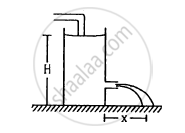
Water level is maintained in a cylindrical vessel up to a fixed height H. The vessel is kept on a horizontal plane. At what height above the bottom should a hole be made in the vessel so that the water stream coming out of the hole strikes the horizontal plane at the greatest distance from the vessel.
The surface tension of a liquid at critical temperature is ______
A certain number of spherical drops of a liquid of radius R coalesce to form a single drop of radius R and volume V. If T is the surface tension of the liquid, then
What are the factors affecting the surface tension of a liquid?
What do you mean by capillarity or capillary action?
Water rises in a capillary tube of radius r upto a height h. The mass of water in a capillary is m. The mass of water that will rise in a capillary of radius `"r"/4` will be ______.
Define angle of contact.
