Advertisements
Advertisements
प्रश्न
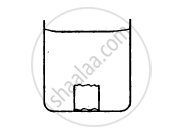
A metal piece of mass 160 g lies in equilibrium inside a glass of water. The piece touches the bottom of the glass at a small number of points. If the density of the metal is 8000 kg/m3, find the normal force exerted by the bottom of the glass on the metal piece.
Advertisements
उत्तर
Given:
Mass of the metal piece, m =160 gm = 160 × 10−3 kg
Density of the metal piece, ρm = 8000 kg/m3
Density of the water, ρw = 1000 kg/m3
Let R be the normal reaction and U be the upward thrust.
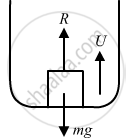
From the diagram, we have:
mg = U + R
⇒ R = mg −Vρwg [U = Vρwg]
\[\Rightarrow \text{R = mg }- \frac{\text{m}}{\rho_\text{m}} \times \rho_\text{w} \times \text{g}\]
\[= 160 \times {10}^{- 3} \times \left( 10 - \frac{{10}^3 \times 10}{8000} \right)\]
\[ = 160 \times {10}^{- 3} \times 10\left( 1 - \frac{1}{8} \right)\]
\[ = 1 . 4 \text{N }\]
APPEARS IN
संबंधित प्रश्न
Derive Laplace’s law for spherical membrane of bubble due to surface tension.
Explain why Water with detergent dissolved in it should have small angles of contact.
A U-shaped wire is dipped in a soap solution and removed. The thin soap film formed between the wire and the light slider supports a weight of 1.5 × 10⁻² N (which includes the small weight of the slider). The length of the slider is 30 cm. What is the surface tension of the film?
By a surface of a liquid we mean
An ice cube is suspended in vacuum in a gravity free hall. As the ice melts it
Viscosity is a property of
Find the excess pressure inside (a) a drop of mercury of radius 2 mm (b) a soap bubble of radius 4 mm and (c) an air bubble of radius 4 mm formed inside a tank of water. Surface tension of mercury, soap solution and water are 0.465 N m−1, 0.03 N m−1 and 0.076 N m−1 respectively.
Two large glass plates are placed vertically and parallel to each other inside a tank of water with separation between the plates equal to 1 mm. Find the rise of water in the space between the plates. Surface tension of water = 0.075 Nm−1.
Insect moves over the surface of water because of ______.
The water droplets are spherical in free fall due to ______
The property of _______ of a liquid surface enables the water droplets to move upward in plants.
A capillary of diameter d mm is dipped in water such that the water rises to a height of 30 mm. If the radius of the capillary is made `(2/3)` of its previous value, then compute the height up to which water will rise in the new capillary?
Why coffee runs up into a sugar lump (a small cube of sugar) when one corner of the sugar lump is held in the liquid?
The excess of pressure, due to surface tension, on a spherical liquid drop of radius 'R' is proportional to ______.
The angle of contact at the interface of water-glass is 0°, Ethylalcohol-glass is 0°, Mercury-glass is 140° and Methyliodide-glass is 30°. A glass capillary is put in a trough containing one of these four liquids. It is observed that the meniscus is convex. The liquid in the trough is ______.
The free surface of oil in a tanker, at rest, is horizontal. If the tanker starts accelerating the free surface will be titled by an angle θ. If the acceleration is a ms–2, what will be the slope of the free surface?
A soap bubble of radius 3 cm is formed inside another soap bubble of radius 6 cm. The radius of an equivalent soap bubble which has the same excess pressure as inside the smaller bubble with respect to the atmospheric pressure is ______ cm.
A coaxial cylinder made of glass is immersed in liquid of surface tension ' S'. Radius of inner and outer surface of cylinder are R1 and R2 respectively. Height till which liquid will rise is (Density of liquid is p):
The surface tension of boiling water is ______.
