Advertisements
Advertisements
Question
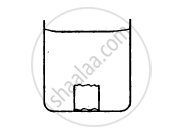
A metal piece of mass 160 g lies in equilibrium inside a glass of water. The piece touches the bottom of the glass at a small number of points. If the density of the metal is 8000 kg/m3, find the normal force exerted by the bottom of the glass on the metal piece.
Advertisements
Solution
Given:
Mass of the metal piece, m =160 gm = 160 × 10−3 kg
Density of the metal piece, ρm = 8000 kg/m3
Density of the water, ρw = 1000 kg/m3
Let R be the normal reaction and U be the upward thrust.
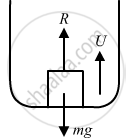
From the diagram, we have:
mg = U + R
⇒ R = mg −Vρwg [U = Vρwg]
\[\Rightarrow \text{R = mg }- \frac{\text{m}}{\rho_\text{m}} \times \rho_\text{w} \times \text{g}\]
\[= 160 \times {10}^{- 3} \times \left( 10 - \frac{{10}^3 \times 10}{8000} \right)\]
\[ = 160 \times {10}^{- 3} \times 10\left( 1 - \frac{1}{8} \right)\]
\[ = 1 . 4 \text{N }\]
APPEARS IN
RELATED QUESTIONS
The energy of the free surface of a liquid drop is 5π times the surface tension of the liquid. Find the diameter of the drop in C.G.S. system.
In which of the following substances, surface tension increases with increase in temperature ?
- Copper
- Molten copper
- Iron
- Molten iron
Explain why The angle of contact of mercury with glass is obtuse, while that of water with glass is acute
The total energy of free surface of a liquid drop is 2π times the surface tension of the liquid. What is the diameter of the drop? (Assume all terms in SI unit).
The free surface of a liquid resting in an inertial frame is horizontal. Does the normal to the free surface pass through the centre of the earth? Think separately if the liquid is (a) at the equator (b) at a pole (c) somewhere else.
Water near the bed of a deep river is quiet while that near the surface flows. Give reasons.
Consider an ice cube of edge 1.0 cm kept in a gravity-free hall. Find the surface area of the water when the ice melts. Neglect the difference in densities of ice and water.
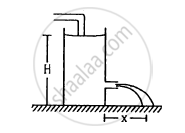
Water level is maintained in a cylindrical vessel up to a fixed height H. The vessel is kept on a horizontal plane. At what height above the bottom should a hole be made in the vessel so that the water stream coming out of the hole strikes the horizontal plane at the greatest distance from the vessel.
Twenty-seven droplets of water, each of radius 0.1 mm coalesce into a single drop. Find the change in surface energy. Surface tension of water is 0.072 N/m.
The surface tension of a liquid at critical temperature is ______
A certain number of spherical drops of a liquid of radius R coalesce to form a single drop of radius R and volume V. If T is the surface tension of the liquid, then
What do you mean by capillarity or capillary action?
Two small drops of mercury each of radius 'R' coalesce to form a large single drop. The ratio of the total surface energies before and after the change is ____________.
The upward force of 105 dyne due to surface tension is balanced by the force due to the weight of the water column and 'h' is the height of water in the capillary. The inner circumference of the capillary is ______.
(surface tension of water = 7 × 10⁻² N/m)
Soap solution is used for cleaning dirty clothes because ______.
The wear and tear in the machine part is due to ______.
The excess pressure inside a liquid drop is 500 Nm-2. If the radius of the drop is 2 mm, the surface tension of the liquid is x × 10-3 Nm-1. The value of x is ______.
A liquid drop of density ρ is floating half immersed in a liquid of density d. The diameter of the liquid drop is ______.
(ρ > d, g = acceleration due to gravity, T = surface tension)
A light metal disc of radius ‘r’ floats on water surface and bends the surface downwards along the perimeter making an angle ‘θ’ with the vertical edge of the disc. If the weight of water displaced by the disc is ‘W’, the weight of the metal disc is ______.
[T = surface tension of water]
