Advertisements
Advertisements
Question
A ferry boat has internal volume 1 m3 and weight 50 kg.(a) Neglecting the thickness of the wood, find the fraction of the volume of the boat immersed in water.(b) If a leak develops in the bottom and water starts coming in, what fraction of the boat's volume will be filled with water before water starts coming in from the sides?
Advertisements
Solution
Internal volume, V = 1 m3 = External volume of the ferry boat
Density of water, \[\rho_w\] = 103 kg/m3
As the weight of the boat is balanced by the buoyant force, we have:
\[\text{mg} = V_1 \times \rho_w \times g\]
\[ \Rightarrow 50 = V_1 \times {10}^3 \]
\[ \Rightarrow V_1 = \frac{5}{100} = 0 . 05 \text{ m}^3\]
(b) Let V2 be the volume of the boat filled with water before water starts coming in from the side.
\[\therefore \text {mg + V}_2 \rho_\text{w} \times \text{g = V} \times \rho_\text{w} \times g [\text{ V is the volume of the water displaced by the boat }. ]\]
\[ \Rightarrow 50 + V_2 \times {10}^3 = 1 \times {10}^3 \]
\[ \Rightarrow V_2 = \frac{{10}^3 - 50}{{10}^3}\]
\[ = \frac{950}{1000} = 0 . 95 \text{ m}^3 \]
Fraction of the boat's volume filled with water\[ = \frac{19}{20}\]
APPEARS IN
RELATED QUESTIONS
Water rises to a height 3.2 cm in a glass capillary tube. Find the height to which the same water will rise in another glass capillary having half area of cross section.
In which of the following substances, surface tension increases with increase in temperature ?
- Copper
- Molten copper
- Iron
- Molten iron
A big drop of radius R is formed from 1000 droplets of water. The radius of a droplet will be _______
A) 10 R
B) R/10
C) R/100
D) R/1000
The force of surface tension acts tangentially to the surface whereas the force due to air pressure acts perpendicularly on the surface. How is then the force due to excess pressure inside a bubble balanced by the force due to the surface tension?
Frictional force between solids operates even when they do not move with respect to each other. Do we have viscous force acting between two layers even if there is no relative motion?
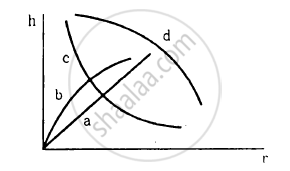
Which of the following graphs may represent the relation between the capillary rise hand the radius r of the capillary?
The lower end of a capillary tube of radius 1 mm is dipped vertically into mercury. (a) Find the depression of mercury column in the capillary. (b) If the length dipped inside is half the answer of part (a), find the angle made by the mercury surface at the end of the capillary with the vertical. Surface tension of mercury = 0.465 N m−1 and the contact angle of mercury with glass −135 °.
A cubical block of wood weighing 200 g has a lead piece fastened underneath. Find the mass of the lead piece which will just allow the block to float in water. Specific gravity of wood is 0.8 and that of lead is 11.3.
The energy stored in a soap bubble of diameter 6 cm and T = 0.04 N/m is nearly ______.
Explain the capillary action.
Two soap bubbles have a radius in the ratio of 2:3. Compare the works done in blowing these bubbles.
Describe an experiment to prove that friction depends on the nature of a surface.
Define the angle of contact for a given pair of solid and liquid.
If the surface tension of a soap solution is 3 × 10⁻² N/m then the work done in forming a soap film of 20 cm × 5 cm will be ______.
The excess of pressure, due to surface tension, on a spherical liquid drop of radius 'R' is proportional to ______.
Under isothermal conditions, two soap bubbles of radii 'r1' and 'r2' coalesce to form a big drop. The radius of the big drop is ______.
The wear and tear in the machine part is due to ______.
What is surface tension? Explain the applications of surface tension.
The free surface of oil in a tanker, at rest, is horizontal. If the tanker starts accelerating the free surface will be titled by an angle θ. If the acceleration is a ms–2, what will be the slope of the free surface?
The surface tension of a soap solution is T. The work done in blowing a soap bubble of diameter d to that of a diameter 2d is ______.
