Advertisements
Advertisements
Question
If water in one flask and castor oil in other are violently shaken and kept on a table, which will come to rest earlier?
Advertisements
Solution
Castor oil will come to rest more quickly because it has a greater coefficient of viscosity than water.
Castor oil has a higher viscosity than water. It will therefore, lose kinetic energy and come to rest faster than water.
APPEARS IN
RELATED QUESTIONS
The surface tension of water at 0°C is 75.5 dyne/cm. Calculate surface tension of water at 25°C.
(α for water = 2.7×10⁻³/°C)
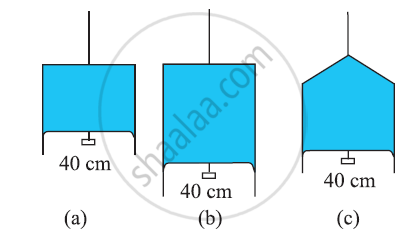
Figure (a) shows a thin liquid film supporting a small weight = 4.5 × 10⁻² N. What is the weight supported by a film of the same liquid at the same temperature in Fig. (b) and (c)? Explain your answer physically.
Mercury has an angle of contact equal to 140° with soda lime glass. A narrow tube of radius 1.00 mm made of this glass is dipped in a trough containing mercury. By what amount does the mercury dip down in the tube relative to the liquid surface outside? Surface tension of mercury at the temperature of the experiment is 0.465 N m–1. Density of mercury = 13.6 × 10³ kg m–3
The total free surface energy of a liquid drop is `pisqrt2` times the surface tension of the liquid. Calculate the diameter of the drop in S.l. unit.
If a mosquito is dipped into water and released, it is not able to fly till it is dry again. Explain
If two soap bubbles of different radii are connected by a tube,
Viscosity is a property of
The rise of a liquid in a capillary tube depends on
(a) the material
(b) the length
(c) the outer radius
(d) the inner radius of the tube
The contact angle between a solid and a liquid is a property of
(a) the material of the solid
(b) the material of the liquid
(c) the shape of the solid
(d) the mass of the solid
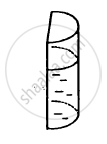
A liquid is contained in a vertical tube of semicircular cross section. The contact angle is zero. The force of surface tension on the curved part and on the flat part are in ratio
A capillary tube of radius 0.50 mm is dipped vertically in a pot of water. Find the difference between the pressure of the water in the tube 5.0 cm below the surface and the atmospheric pressure. Surface tension of water = 0.075 N m−1.
The water droplets are spherical in free fall due to ______
Define the angle of contact for a given pair of solid and liquid.
Obtain an expression for the surface tension of a liquid by the capillary rise method.
What is surface tension? Explain the applications of surface tension.
Two mercury droplets of radii 0.1 cm. and 0.2 cm. collapse into one single drop. What amount of energy is released? The surface tension of mercury T = 435.5 × 10⁻³ Nm–1.
Two mercury droplets of radii 0.1 cm. and 0.2 cm. collapse into one single drop. What amount of energy is released? The surface tension of mercury T = 435.5 × 10⁻³ Nm–1.
A drop of water and a soap bubble have the same radii. Surface tension of soap solution is half of that of water. The ratio of excess pressure inside the drop and bubble is ______.
When one end of the capillary is dipped in water, the height of water column is 'h'. The upward force of 105 dyne due to surface tension is balanced by the force due to the weight of water column. The inner circumference of capillary is ______.
(Surface tension of water = 7 × 10⁻² N/m)
In most liquids, with the rise in temperature, the surface tension of a liquid ______.
