Advertisements
Advertisements
Question
A U-shaped wire is dipped in a soap solution and removed. The thin soap film formed between the wire and the light slider supports a weight of 1.5 × 10⁻² N (which includes the small weight of the slider). The length of the slider is 30 cm. What is the surface tension of the film?
Advertisements
Solution 1
The weight that the soap film supports, W = 1.5 × 10⁻² N
Length of the slider, l = 30 cm = 0.3 m
A soap film has two free surfaces.
∴Total length = 2l = 2 × 0.3 = 0.6 m
Surface tension, `S = "Force of Weight"/"2l"`
`= (1.5 xx 10^(-2))/0.6 = 2.5 xx 10^(-2) "N/m"`
Therefore, the surface tension of the film is 2.5 × 10⁻² N m–1.
Solution 2
In present case force of surface tension is balancing the weight of 1.5 x 10⁻² N, hence force of surface tension, F = 1.5 x 10⁻² N.
Total length of liquid film, l = 2 x 30 cm = 60 cm = 0.6 m because the liquid film has two surfaces.
Surface tension, T = F/l =1.5 x 10⁻² N/0.6m =2.5 x 10⁻² Nm-1
APPEARS IN
RELATED QUESTIONS
Derive Laplace’s law for spherical membrane of bubble due to surface tension.
A body weighs 4.0 kg-wt on the surface of the Earth. What will be its weight on the surface of a plant whose mass is `1/8` th of the mass of the Earth and radius half `(1/2)` of that of the Earth?
A big drop of radius R is formed from 1000 droplets of water. The radius of a droplet will be _______
A) 10 R
B) R/10
C) R/100
D) R/1000
When a glass capillary tube is dipped at one end in water, water rises in the tube. The gravitational potential energy is thus increased. Is it a violation of conservation of energy?
If a mosquito is dipped into water and released, it is not able to fly till it is dry again. Explain
By a surface of a liquid we mean
If two soap bubbles of different radii are connected by a tube,
Which of the following graphs may represent the relation between the capillary rise hand the radius r of the capillary?
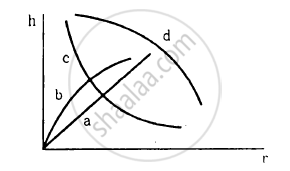
The lower end of a capillary tube is immersed in mercury. The level of mercury in the tube is found to be 2 cm below the outer level. If the same tube is immersed in water, up to what height will the water rise in the capillary?
A cubical block of wood weighing 200 g has a lead piece fastened underneath. Find the mass of the lead piece which will just allow the block to float in water. Specific gravity of wood is 0.8 and that of lead is 11.3.
A solid sphere of radius 5 cm floats in water. If a maximum load of 0.1 kg can be put on it without wetting the load, find the specific gravity of the material of the sphere.
A drop of mercury of radius 0.2 cm is broken into 8 droplets of the same size. Find the work done if the surface tension of mercury is 435.5 dyn/cm.
Explain the phenomena of surface tension on the basis of molecular theory.
A u-tube is made up of capillaries of bore 1 mm and 2 mm respectively. The tube is held vertically and partially filled with a liquid of surface tension 49 dyne/cm and zero angles of contact. Calculate the density of the liquid, if the difference in the levels of the meniscus is 1.25 cm. take g = 980 cm/s2
A certain number of spherical drops of a liquid of radius R coalesce to form a single drop of radius R and volume V. If T is the surface tension of the liquid, then
Mention the S.I unit and dimension of surface tension.
Two spherical rain drops reach the surface of the earth with terminal velocities having ratio 16 : 9. The ratio of their surface area is ______.
For a surface molecule ______.
- the net force on it is zero.
- there is a net downward force.
- the potential energy is less than that of a molecule inside.
- the potential energy is more than that of a molecule inside.
A drop of water and a soap bubble have the same radii. Surface tension of soap solution is half of that of water. The ratio of excess pressure inside the drop and bubble is ______.
