Advertisements
Advertisements
Question
A cubical block of wood weighing 200 g has a lead piece fastened underneath. Find the mass of the lead piece which will just allow the block to float in water. Specific gravity of wood is 0.8 and that of lead is 11.3.
Advertisements
Solution
Given:
Density of wood, ρw = 0.8 gm/cc
Density of lead, ρpb = 11.3 gm/cc
Weight of the cubical wood block, mw = 200 g
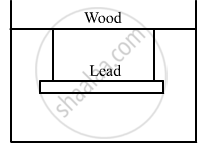
The cubical block floats in water.
Now,
(mw+ mpb) × g = (Vw + Vpb)ρ × g
Here,
ρ = Density of water
Vw = Volume of wood
Vpb = Volume of lead
\[\Rightarrow ( \text{m}_\text{w} + \text{m}_{\text{pb}} ) = \left( \frac{\text{m}_\text{w}}{\rho_\text{w}} + \frac{\text{ m}_{\text{pb}}}{\rho_{\text{pb}}} \right)\rho\]
\[ \Rightarrow (200 + \text{m}_{\text{pb}} ) = \left( \frac{200}{0 . 8} + \frac{\text{m}_{\text{pb}}}{11 . 3} \right) \times 1\]
\[ \Rightarrow \text{m}_{\text{pb}} - \frac{\text{m}_{\text{pb}}}{11 . 3} = 250 - 200\]
\[ \Rightarrow \frac{10 . 3 \text{m}_{\text{pb}}}{11 . 3} = 50\]
\[ \Rightarrow \text{m}_{\text{pb}} = \frac{50 \times 11 . 3}{10 . 3} = 54 . 8 \text{ gm }\]
APPEARS IN
RELATED QUESTIONS
The energy of the free surface of a liquid drop is 5π times the surface tension of the liquid. Find the diameter of the drop in C.G.S. system.
'n' droplets of equal size of radius r coalesce to form a bigger drop of radius R. The energy liberated is equal to...................
(T =Surface tension of water)
`(a) 4piR^2T[n^(1/3)-1]`
`(b) 4pir^2T[n^(1/3)-1]`
`(c) 4piR^2T[n^(2/3)-1]`
`(d)4 pir^2T[n^(2/3)-1]`
The surface tension of water at 0ºc is 75·5 dyne/cm. Find surface tension of water at 25°C. [ α for water = 0·0021/°C ]
Explain why Water with detergent dissolved in it should have small angles of contact.
A body weighs 4.0 kg-wt on the surface of the Earth. What will be its weight on the surface of a plant whose mass is `1/8` th of the mass of the Earth and radius half `(1/2)` of that of the Earth?
When a sparingly soluble substance like alcohol is dissolved in water, surface tension of water
The free surface of a liquid resting in an inertial frame is horizontal. Does the normal to the free surface pass through the centre of the earth? Think separately if the liquid is (a) at the equator (b) at a pole (c) somewhere else.
The contact angle between pure water and pure silver is 90°. If a capillary tube made of silver is dipped at one end in pure water, will the water rise in the capillary?
The force of surface tension acts tangentially to the surface whereas the force due to air pressure acts perpendicularly on the surface. How is then the force due to excess pressure inside a bubble balanced by the force due to the surface tension?
An ice cube is suspended in vacuum in a gravity free hall. As the ice melts it
If more air is pushed in a soap bubble, the pressure in it
Viscosity is a property of
A ferry boat has internal volume 1 m3 and weight 50 kg.(a) Neglecting the thickness of the wood, find the fraction of the volume of the boat immersed in water.(b) If a leak develops in the bottom and water starts coming in, what fraction of the boat's volume will be filled with water before water starts coming in from the sides?
The water droplets are spherical in free fall due to ______
A u-tube is made up of capillaries of bore 1 mm and 2 mm respectively. The tube is held vertically and partially filled with a liquid of surface tension 49 dyne/cm and zero angles of contact. Calculate the density of the liquid, if the difference in the levels of the meniscus is 1.25 cm. take g = 980 cm/s2
Numerical Problem.
A stone weighs 500 N. Calculate the pressure exerted by it if it makes contact with a surface of area 25 cm2.
Why coffee runs up into a sugar lump (a small cube of sugar) when one corner of the sugar lump is held in the liquid?
A molecule of water on the surface experiences a net ______.
The length of a needle floating on water is 2 cm. The additional force due to surface tension required to pull the needle out of water will be (S.T. of water = 7.0 × 10⁻² N/m).
Two mercury droplets of radii 0.1 cm. and 0.2 cm. collapse into one single drop. What amount of energy is released? The surface tension of mercury T = 435.5 × 10⁻³ Nm–1.
