Advertisements
Advertisements
प्रश्न
A cubical block of wood weighing 200 g has a lead piece fastened underneath. Find the mass of the lead piece which will just allow the block to float in water. Specific gravity of wood is 0.8 and that of lead is 11.3.
Advertisements
उत्तर
Given:
Density of wood, ρw = 0.8 gm/cc
Density of lead, ρpb = 11.3 gm/cc
Weight of the cubical wood block, mw = 200 g
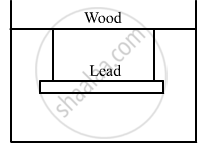
The cubical block floats in water.
Now,
(mw+ mpb) × g = (Vw + Vpb)ρ × g
Here,
ρ = Density of water
Vw = Volume of wood
Vpb = Volume of lead
\[\Rightarrow ( \text{m}_\text{w} + \text{m}_{\text{pb}} ) = \left( \frac{\text{m}_\text{w}}{\rho_\text{w}} + \frac{\text{ m}_{\text{pb}}}{\rho_{\text{pb}}} \right)\rho\]
\[ \Rightarrow (200 + \text{m}_{\text{pb}} ) = \left( \frac{200}{0 . 8} + \frac{\text{m}_{\text{pb}}}{11 . 3} \right) \times 1\]
\[ \Rightarrow \text{m}_{\text{pb}} - \frac{\text{m}_{\text{pb}}}{11 . 3} = 250 - 200\]
\[ \Rightarrow \frac{10 . 3 \text{m}_{\text{pb}}}{11 . 3} = 50\]
\[ \Rightarrow \text{m}_{\text{pb}} = \frac{50 \times 11 . 3}{10 . 3} = 54 . 8 \text{ gm }\]
APPEARS IN
संबंधित प्रश्न
Angle of contact for the pair of pure water with clean glass is _______.
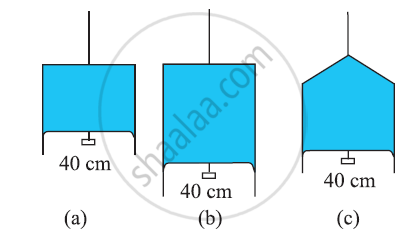
Figure (a) shows a thin liquid film supporting a small weight = 4.5 × 10⁻² N. What is the weight supported by a film of the same liquid at the same temperature in Fig. (b) and (c)? Explain your answer physically.
The total free surface energy of a liquid drop is `pisqrt2` times the surface tension of the liquid. Calculate the diameter of the drop in S.l. unit.
When a sparingly soluble substance like alcohol is dissolved in water, surface tension of water
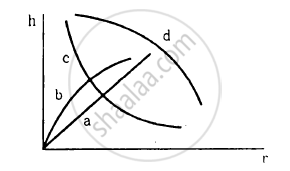
Which of the following graphs may represent the relation between the capillary rise hand the radius r of the capillary?
The lower end of a capillary tube of radius 1 mm is dipped vertically into mercury. (a) Find the depression of mercury column in the capillary. (b) If the length dipped inside is half the answer of part (a), find the angle made by the mercury surface at the end of the capillary with the vertical. Surface tension of mercury = 0.465 N m−1 and the contact angle of mercury with glass −135 °.
A metal piece of mass 160 g lies in equilibrium inside a glass of water. The piece touches the bottom of the glass at a small number of points. If the density of the metal is 8000 kg/m3, find the normal force exerted by the bottom of the glass on the metal piece.
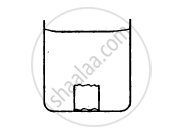
Solve the previous problem if the lead piece is fastened on the top surface of the block and the block is to float with its upper surface just dipping into water.
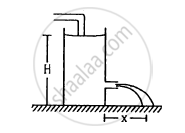
Water level is maintained in a cylindrical vessel up to a fixed height H. The vessel is kept on a horizontal plane. At what height above the bottom should a hole be made in the vessel so that the water stream coming out of the hole strikes the horizontal plane at the greatest distance from the vessel.
Define surface tension.
Water rises to a height of 20 mm in a capillary tube. If the radius made 1/3rd of its previous value, to what height will the water now rise in the tube?
Define the surface tension of a liquid.
Obtain an expression for the excess of pressure inside a
- liquid drop
- liquid bubble
- air bubble
Why coffee runs up into a sugar lump (a small cube of sugar) when one corner of the sugar lump is held in the liquid?
Two small drops of mercury each of radius 'R' coalesce to form a large single drop. The ratio of the total surface energies before and after the change is ____________.
A molecule of water on the surface experiences a net ______.
Two mercury droplets of radii 0.1 cm. and 0.2 cm. collapse into one single drop. What amount of energy is released? The surface tension of mercury T = 435.5 × 10⁻³ Nm–1.
Eight droplets of water each of radius 0.2 mm coalesce into a single drop. Find the decrease in the surface area.
The surface tension of soap solution is 25 × 10-3 Nm-1. The excess of pressure inside a soap bubble of diameter 1 cm is ______.
In most liquids, with the rise in temperature, the surface tension of a liquid ______.
