Advertisements
Advertisements
प्रश्न
A cubical block of wood weighing 200 g has a lead piece fastened underneath. Find the mass of the lead piece which will just allow the block to float in water. Specific gravity of wood is 0.8 and that of lead is 11.3.
Advertisements
उत्तर
Given:
Density of wood, ρw = 0.8 gm/cc
Density of lead, ρpb = 11.3 gm/cc
Weight of the cubical wood block, mw = 200 g
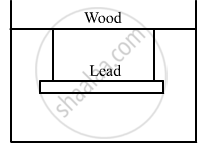
The cubical block floats in water.
Now,
(mw+ mpb) × g = (Vw + Vpb)ρ × g
Here,
ρ = Density of water
Vw = Volume of wood
Vpb = Volume of lead
\[\Rightarrow ( \text{m}_\text{w} + \text{m}_{\text{pb}} ) = \left( \frac{\text{m}_\text{w}}{\rho_\text{w}} + \frac{\text{ m}_{\text{pb}}}{\rho_{\text{pb}}} \right)\rho\]
\[ \Rightarrow (200 + \text{m}_{\text{pb}} ) = \left( \frac{200}{0 . 8} + \frac{\text{m}_{\text{pb}}}{11 . 3} \right) \times 1\]
\[ \Rightarrow \text{m}_{\text{pb}} - \frac{\text{m}_{\text{pb}}}{11 . 3} = 250 - 200\]
\[ \Rightarrow \frac{10 . 3 \text{m}_{\text{pb}}}{11 . 3} = 50\]
\[ \Rightarrow \text{m}_{\text{pb}} = \frac{50 \times 11 . 3}{10 . 3} = 54 . 8 \text{ gm }\]
APPEARS IN
संबंधित प्रश्न
The energy of the free surface of a liquid drop is 5π times the surface tension of the liquid. Find the diameter of the drop in C.G.S. system.
Explain why Surface tension of a liquid is independent of the area of the surface
Calculate the work done in increasing the radius of a soap bubble in air from 1 cm to 2 cm. The surface tension of soap solution is 30 dyne/cm. (Π = 3.142).
The force of surface tension acts tangentially to the surface whereas the force due to air pressure acts perpendicularly on the surface. How is then the force due to excess pressure inside a bubble balanced by the force due to the surface tension?
Water near the bed of a deep river is quiet while that near the surface flows. Give reasons.
An ice cube is suspended in vacuum in a gravity free hall. As the ice melts it
A capillary tube of radius 0.50 mm is dipped vertically in a pot of water. Find the difference between the pressure of the water in the tube 5.0 cm below the surface and the atmospheric pressure. Surface tension of water = 0.075 N m−1.
A wire forming a loop is dipped into soap solution and taken out so that a film of soap solution is formed. A loop of 6.28 cm long thread is gently put on the film and the film is pricked with a needle inside the loop. The thread loop takes the shape of a circle. Find the tension the the thread. Surface tension of soap solution = 0.030 N m−1.
A cubical box is to be constructed with iron sheets 1 mm in thickness. What can be the minimum value of the external edge so that the cube does not sink in water? Density of iron = 8000 kg/m3 and density of water = 1000 kg/m3.
How much amount of work is done in forming a soap bubble of radius r?
A u-tube is made up of capillaries of bore 1 mm and 2 mm respectively. The tube is held vertically and partially filled with a liquid of surface tension 49 dyne/cm and zero angles of contact. Calculate the density of the liquid, if the difference in the levels of the meniscus is 1.25 cm. take g = 980 cm/s2
The property of _______ of a liquid surface enables the water droplets to move upward in plants.
Two small drops of mercury each of radius 'R' coalesce to form a large single drop. The ratio of the total surface energies before and after the change is ____________.
Soap solution is used for cleaning dirty clothes because ______.
We have three identical perfectly black plates. The temperatures of first and third plate is T and 3T. What is the temperature of second plate if system is in equilibrium?

A coaxial cylinder made of glass is immersed in liquid of surface tension ' S'. Radius of inner and outer surface of cylinder are R1 and R2 respectively. Height till which liquid will rise is (Density of liquid is p):
The excess pressure inside a liquid drop is 500 Nm-2. If the radius of the drop is 2 mm, the surface tension of the liquid is x × 10-3 Nm-1. The value of x is ______.
When one end of the capillary is dipped in water, the height of water column is 'h'. The upward force of 105 dyne due to surface tension is balanced by the force due to the weight of water column. The inner circumference of capillary is ______.
(Surface tension of water = 7 × 10⁻² N/m)
Two blocks of masses m and M are connected by means of a metal wire of cross-sectional area A passing over a frictionless fixed pully as shown in the figure. The system is then released. If M = 2m, then the stress produced in the wire is ______.

