Advertisements
Advertisements
प्रश्न
A capillary tube of radius 1 mm is kept vertical with the lower end in water. (a) Find the height of water raised in the capillary. (b) If the length of the capillary tube is half the answer of part , find the angle θ made by the water surface in the capillary with the wall.
Advertisements
उत्तर
Given:
Radius of capillary tube r = 1 mm = 10−3 m
(a) Let T be the surface tension and ρ be the density of the liquid.
Then, for cos θ = 1, height (h) of liquid level:\[h = \frac{2T}{r\rho g}\] ........... (i),
where g is the acceleration due to gravity
\[\Rightarrow \text{ h } = \frac{2 \times \left( 0 . 076 \right)}{{10}^{- 3} \times 10 \times 100}\]
\[ = 1 . 52 \text{ cm} \]
\[ = 1 . 52 \times {10}^{- 2} \text{ m }\]
\[ = 1 . 52 \text{ cm }\]
(b) Let the new length of the tube be h'.
\[\text{ h }' = \frac{2T\cos \theta}{\text{ r }\rho \text{ g }}\]
\[\cos \theta = \frac{\text{ h'r }\rho g}{2T}\]
\[\text{ Using equation }\left( \text{ i } \right), \text{ we get: }\]
\[\cos \theta = \frac{h'}{h} = \frac{1}{2} \left( \text{ Because h' }= \frac{h}{2} \right)\]
\[ \Rightarrow \theta = \cos^{- 1} \left( \frac{1}{2} \right) = 60^\circ\]
The water surface in the capillary makes an angle of 60∘with the wall.
APPEARS IN
संबंधित प्रश्न
Angle of contact for the pair of pure water with clean glass is _______.
Fill in the blanks using the word(s) from the list appended with each statement
Surface tension of liquids generally . . . with temperatures (increases / decreases)
Mercury has an angle of contact equal to 140° with soda lime glass. A narrow tube of radius 1.00 mm made of this glass is dipped in a trough containing mercury. By what amount does the mercury dip down in the tube relative to the liquid surface outside? Surface tension of mercury at the temperature of the experiment is 0.465 N m–1. Density of mercury = 13.6 × 10³ kg m–3
The total free surface energy of a liquid drop is `pisqrt2` times the surface tension of the liquid. Calculate the diameter of the drop in S.l. unit.
In a conical pendulum, a string of length 120 cm is fixed at rigid support and carries a mass
of 150 g at its free end. If the mass is revolved in a horizontal circle of radius 0.2 m around a
vertical axis, calculate tension in the string (g = 9.8 m/s2)
The excess pressure inside a soap bubble is twice the excess pressure inside a second soap bubble. The volume of the first bubble is n times the volume of the second where n is
Viscosity is a property of
The contact angle between a solid and a liquid is a property of
(a) the material of the solid
(b) the material of the liquid
(c) the shape of the solid
(d) the mass of the solid
A liquid is contained in a vertical tube of semicircular cross section. The contact angle is zero. The force of surface tension on the curved part and on the flat part are in ratio
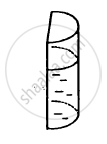
When a capillary tube is dipped into a liquid, the liquid neither rises nor falls in the capillary.
(a) The surface tension of the liquid must be zero.
(b) The contact angle must be 90°.
(c) The surface tension may be zero.
(d) The contact angle may be 90°.
Find the surface energy of water kept in a cylindrical vessel of radius 6.0 cm. Surface tension of water = 0.075 J m−2.
The water droplets are spherical in free fall due to ______
A u-tube is made up of capillaries of bore 1 mm and 2 mm respectively. The tube is held vertically and partially filled with a liquid of surface tension 49 dyne/cm and zero angles of contact. Calculate the density of the liquid, if the difference in the levels of the meniscus is 1.25 cm. take g = 980 cm/s2
How does surface tension help a plant?
Distinguish between cohesive and adhesive forces.
Why coffee runs up into a sugar lump (a small cube of sugar) when one corner of the sugar lump is held in the liquid?
Why is raindrop spherical in nature?
Two mercury droplets of radii 0.1 cm. and 0.2 cm. collapse into one single drop. What amount of energy is released? The surface tension of mercury T = 435.5 × 10⁻³ Nm–1.
The surface tension of a soap solution is T. The work done in blowing a soap bubble of diameter d to that of a diameter 2d is ______.
The surface tension of soap solution is 25 × 10-3 Nm-1. The excess of pressure inside a soap bubble of diameter 1 cm is ______.
