Advertisements
Advertisements
प्रश्न
If a drop of liquid breaks into smaller droplets, it results in lowering of temperature of the droplets. Let a drop of radius R, break into N small droplets each of radius r. Estimate the drop in temperature.
Advertisements
उत्तर
When a big drop of radius R, breaks into N droplets each of radius r, the volume remains constant.
∴ Volume of big drop = N × Volume of each small drop
`4/3 πR^3 = N xx 4/3 πR^3`
or `R^3 = Nr^3`
or `N = R^3/r^3`
Now, the change in surface area = `4πR^2 - N4πr^2`
= `4π(R^2 - Nr^2)`
The energy released = T × ΔA
= `S xx 4π(R^2 - Nr^2)` .....[T = Surface tension]
Due to releasing of this energy. the temperature is lowered.
If ρ is the density and s is the specific heat of liquid and its temperature is lowered by Δθ then the energy released = msΔθ ......[s = specific heat Δθ = change in temperature]
`T xx 4π(R^2 - Nr^2) = (4/3 xx R^3 xx ρ)sΔθ` ......`[∴m = vρ = 4/3 πR^3ρ]`
⇒ Δθ = `(T xx 4π(R^2 - Nr^2))/(4/3 πR^3 ρ xx s)`
= `(3T)/(ρs) [R^2/R^3 - (Nr^2)/R^3]`
= `(3T)/(ρs) [1/R - ((R^3-r^3) xx r^2)/R^3]`
= `(3T)/(ρs) [1/R - 1/r]`
APPEARS IN
संबंधित प्रश्न
Water rises to a height 3.2 cm in a glass capillary tube. Find the height to which the same water will rise in another glass capillary having half area of cross section.
In which of the following substances, surface tension increases with increase in temperature ?
- Copper
- Molten copper
- Iron
- Molten iron
Explain why The angle of contact of mercury with glass is obtuse, while that of water with glass is acute
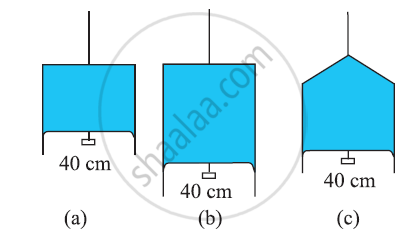
Figure (a) shows a thin liquid film supporting a small weight = 4.5 × 10⁻² N. What is the weight supported by a film of the same liquid at the same temperature in Fig. (b) and (c)? Explain your answer physically.
The total energy of free surface of a liquid drop is 2π times the surface tension of the liquid. What is the diameter of the drop? (Assume all terms in SI unit).
The contact angle between water and glass is 0°. When water is poured in a glass to the maximum of its capacity, the water surface is convex upward. The angle of contact in such a situation is more than 90°. Explain.
Frictional force between solids operates even when they do not move with respect to each other. Do we have viscous force acting between two layers even if there is no relative motion?
A capillary tube of radius 1 mm is kept vertical with the lower end in water. (a) Find the height of water raised in the capillary. (b) If the length of the capillary tube is half the answer of part , find the angle θ made by the water surface in the capillary with the wall.
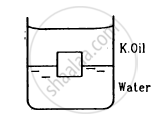
A cube of ice floats partly in water and partly in K.oil (in the following figure). Find the ratio of the volume of ice immersed in water to that in K.oil. Specific gravity of K.oil is 0.8 and that of ice is 0.9.
A cubical block of wood weighing 200 g has a lead piece fastened underneath. Find the mass of the lead piece which will just allow the block to float in water. Specific gravity of wood is 0.8 and that of lead is 11.3.
The wettability of a surface by a liquid depends primarily on
How is surface tension related to surface energy?
Define the angle of contact for a given pair of solid and liquid.
Obtain an expression for the excess of pressure inside a
- liquid drop
- liquid bubble
- air bubble
A spherical soap bubble A of radius 2 cm is formed inside another bubble B of radius 4 cm. Show that the radius of a single soap bubble which maintains the same pressure difference as inside the smaller and outside the larger soap bubble is lesser than the radius of both soap bubbles A and B.
Two small drops of mercury each of radius 'R' coalesce to form a large single drop. The ratio of the total surface energies before and after the change is ____________.
For a surface molecule ______.
- the net force on it is zero.
- there is a net downward force.
- the potential energy is less than that of a molecule inside.
- the potential energy is more than that of a molecule inside.
A soap bubble of radius 3 cm is formed inside another soap bubble of radius 6 cm. The radius of an equivalent soap bubble which has the same excess pressure as inside the smaller bubble with respect to the atmospheric pressure is ______ cm.
In most liquids, with the rise in temperature, the surface tension of a liquid ______.
