Advertisements
Advertisements
Question
If a drop of liquid breaks into smaller droplets, it results in lowering of temperature of the droplets. Let a drop of radius R, break into N small droplets each of radius r. Estimate the drop in temperature.
Advertisements
Solution
When a big drop of radius R, breaks into N droplets each of radius r, the volume remains constant.
∴ Volume of big drop = N × Volume of each small drop
`4/3 πR^3 = N xx 4/3 πR^3`
or `R^3 = Nr^3`
or `N = R^3/r^3`
Now, the change in surface area = `4πR^2 - N4πr^2`
= `4π(R^2 - Nr^2)`
The energy released = T × ΔA
= `S xx 4π(R^2 - Nr^2)` .....[T = Surface tension]
Due to releasing of this energy. the temperature is lowered.
If ρ is the density and s is the specific heat of liquid and its temperature is lowered by Δθ then the energy released = msΔθ ......[s = specific heat Δθ = change in temperature]
`T xx 4π(R^2 - Nr^2) = (4/3 xx R^3 xx ρ)sΔθ` ......`[∴m = vρ = 4/3 πR^3ρ]`
⇒ Δθ = `(T xx 4π(R^2 - Nr^2))/(4/3 πR^3 ρ xx s)`
= `(3T)/(ρs) [R^2/R^3 - (Nr^2)/R^3]`
= `(3T)/(ρs) [1/R - ((R^3-r^3) xx r^2)/R^3]`
= `(3T)/(ρs) [1/R - 1/r]`
APPEARS IN
RELATED QUESTIONS
Derive Laplace’s law for spherical membrane of bubble due to surface tension.
Draw a neat labelled diagram showing forces acting on the meniscus of water in a capillary tube.
Water rises to a height 3.2 cm in a glass capillary tube. Find the height to which the same water will rise in another glass capillary having half area of cross section.
Explain why Water on a clean glass surface tends to spread out while mercury on the same surface tends to form drops. (Put differently, water wets glass while mercury does not.)
Mercury has an angle of contact equal to 140° with soda lime glass. A narrow tube of radius 1.00 mm made of this glass is dipped in a trough containing mercury. By what amount does the mercury dip down in the tube relative to the liquid surface outside? Surface tension of mercury at the temperature of the experiment is 0.465 N m–1. Density of mercury = 13.6 × 10³ kg m–3
Two narrow bores of diameters 3.0 mm and 6.0 mm are joined together to form a U-tube open at both ends. If the U-tube contains water, what is the difference in its levels in the two limbs of the tube? Surface tension of water at the temperature of the experiment is 7.3 × 10⁻² N m–1. Take the angle of contact to be zero and density of water to be 1.0 × 10³ kg m–3 (g = 9.8 m s–2)
A big drop of radius R is formed from 1000 droplets of water. The radius of a droplet will be _______
A) 10 R
B) R/10
C) R/100
D) R/1000
Frictional force between solids operates even when they do not move with respect to each other. Do we have viscous force acting between two layers even if there is no relative motion?
Water near the bed of a deep river is quiet while that near the surface flows. Give reasons.
By a surface of a liquid we mean
The rise of a liquid in a capillary tube depends on
(a) the material
(b) the length
(c) the outer radius
(d) the inner radius of the tube
Consider a small surface area of 1 mm2 at the top of a mercury drop of radius 4.0 mm. Find the force exerted on this area (a) by the air above it (b) by the mercury below it and (c) by the mercury surface in contact with it. Atmospheric pressure = 1.0 × 10⁵ Pa and surface tension of mercury = 0.465 N m−1. Neglect the effect of gravity. Assume all numbers to be exact.
Find the force exerted by the water on a 2 m2 plane surface of a large stone placed at the bottom of a sea 500 m deep. Does the force depend on the orientation of the surface?
Water rises to a height of 20 mm in a capillary tube. If the radius made 1/3rd of its previous value, to what height will the water now rise in the tube?
Numerical Problem.
A stone weighs 500 N. Calculate the pressure exerted by it if it makes contact with a surface of area 25 cm2.
Two small drops of mercury each of radius 'R' coalesce to form a large single drop. The ratio of the total surface energies before and after the change is ____________.
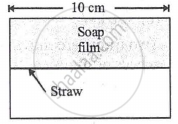
A soap film of surface tension 3 × 10⁻² formed in a rectangular frame can support a straw as shown in Fig. If g = 10 ms-12, the mass of the straw is ______.
The surface tension of a soap solution is T. The work done in blowing a soap bubble of diameter d to that of a diameter 2d is ______.
Two blocks of masses m and M are connected by means of a metal wire of cross-sectional area A passing over a frictionless fixed pully as shown in the figure. The system is then released. If M = 2m, then the stress produced in the wire is ______.

