Advertisements
Advertisements
Question
Two mercury droplets of radii 0.1 cm. and 0.2 cm. collapse into one single drop. What amount of energy is released? The surface tension of mercury T = 435.5 × 10⁻³ Nm–1.
Advertisements
Solution
When two drops form a bigger drop, volume remains conserved.
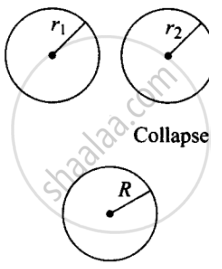
According to the problem, there is two mercury droplets of different radii collapse into one single drop.
Radius of smaller drop = r1 = 0.1 cm = 10–3 m
Radius of bigger drop = r2 = 0.2 cm = 2 × 10⁻³ m
Surface tension (T) = 435.5 × 10⁻³ N/m
Let V1 and V2 be the volumes of these two mercury droplets and the volume of big drops formed by collapsing is V.
The volume of a big drop = Volume of small droplets
`V = V_1 + V_2`
`4/3 πR^3 = 4/3 πr_1^3 + 4/3 πr_2^3`
or `R^3 = r_1^3 + r_2^3`
= (0.1)3 + (0.2)3
= 0.001 + 0.008
= 0.009
or R = 0.21 cm = 2 × 10⁻³ m
∴ Decrease in surface area,
ΔA = `4πR^2 - (4πr_1^2 + 4πr_2^2)`
= `4π[R^2 - (r_1^2 + r_2^2)]`
Energy released,
`E = T xx ΔA`
= `T xx 4π[R^2 - (r_1^2 + r_2^2)]`
= `435.5 xx 10^-3 xx 4 xx 3.14[(2.1 xx 10^-3)^2 - (1 xx 10^-6 + 4 xx 10^-6)]`
= `435.5 xx 4 xx 3.14[4.41 - 5] xx 10^-6 xx 10^-3`
= – 32.23 × 10⁻⁷ ......(Negative sign shows absorption)
Therefore, 3.22 × K–6 J energy will be absorbed. So, the surface area of the water decreases means the surface area of bigger drop is less than the sum of surface area of two smaller drops.
APPEARS IN
RELATED QUESTIONS
Water rises to a height 3.2 cm in a glass capillary tube. Find the height to which the same water will rise in another glass capillary having half area of cross section.
In which of the following substances, surface tension increases with increase in temperature ?
- Copper
- Molten copper
- Iron
- Molten iron
Explain why Water with detergent dissolved in it should have small angles of contact.
Mercury has an angle of contact equal to 140° with soda lime glass. A narrow tube of radius 1.00 mm made of this glass is dipped in a trough containing mercury. By what amount does the mercury dip down in the tube relative to the liquid surface outside? Surface tension of mercury at the temperature of the experiment is 0.465 N m–1. Density of mercury = 13.6 × 10³ kg m–3
Show that the surface tension of a liquid is numerically equal to the surface energy per unit
area.
A uniform vertical tube of circular cross section contains a liquid. The contact angle is 90°. Consider a diameter of the tube lying in the surface of the liquid. The surface to the right of this diameter pulls the surface on the left of it. What keeps the surface on the left in equilibrium?
Viscosity is a property of
Consider a small surface area of 1 mm2 at the top of a mercury drop of radius 4.0 mm. Find the force exerted on this area (a) by the air above it (b) by the mercury below it and (c) by the mercury surface in contact with it. Atmospheric pressure = 1.0 × 10⁵ Pa and surface tension of mercury = 0.465 N m−1. Neglect the effect of gravity. Assume all numbers to be exact.
A cubical block of wood weighing 200 g has a lead piece fastened underneath. Find the mass of the lead piece which will just allow the block to float in water. Specific gravity of wood is 0.8 and that of lead is 11.3.
A hollow spherical body of inner and outer radii 6 cm and 8 cm respectively floats half-submerged in water. Find the density of the material of the sphere.
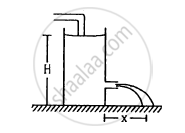
Water level is maintained in a cylindrical vessel up to a fixed height H. The vessel is kept on a horizontal plane. At what height above the bottom should a hole be made in the vessel so that the water stream coming out of the hole strikes the horizontal plane at the greatest distance from the vessel.
Explain the capillary action.
Two soap bubbles have a radius in the ratio of 2:3. Compare the works done in blowing these bubbles.
A certain number of spherical drops of a liquid of radius R coalesce to form a single drop of radius R and volume V. If T is the surface tension of the liquid, then
For a surface molecule ______.
- the net force on it is zero.
- there is a net downward force.
- the potential energy is less than that of a molecule inside.
- the potential energy is more than that of a molecule inside.
The sap in trees, which consists mainly of water in summer, rises in a system of capillaries of radius r = 2.5 × 10⁻⁵ m. The surface tension of sap is T = 7.28 × 10⁻² Nm–1 and the angle of contact is 0°. Does surface tension alone account for the supply of water to the top of all trees?
Eight droplets of water each of radius 0.2 mm coalesce into a single drop. Find the decrease in the surface area.
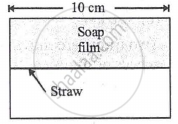
A soap film of surface tension 3 × 10⁻² formed in a rectangular frame can support a straw as shown in Fig. If g = 10 ms-12, the mass of the straw is ______.
A liquid drop of density ρ is floating half immersed in a liquid of density d. The diameter of the liquid drop is ______.
(ρ > d, g = acceleration due to gravity, T = surface tension)
A drop of water of radius 8 mm breaks into number of droplets each of radius 1 mm. How many droplets will be formed?
