Advertisements
Advertisements
Question
A drop of mercury of radius 2 mm is split into 8 identical droplets. Find the increase in surface energy. Surface tension of mercury = 0.465 J m−2.
Advertisements
Solution
Given:
Initial radius of mercury drop R = 2 mm = 2 × 10⁻³ m
Surface tension of mercury T = 0.465 J/m2
Let the radius of a small drop of mercury be r.
As one big drop is split into 8 identical droplets:
volume of initial drop = 8 × (volume of a small drop)
\[ \left( \frac{4}{3} \right)\pi R^3 = \left( \frac{4}{3} \right)\pi r^3 \times 8\]
Taking cube root on both sides of the above equation: \[r\]\[=\]\[\frac{R}{2}\]\[=\]\[10\]\[\]-3 m
Surface energy = T × surface area
∴ Increase in surface energy = TA' − TA
= (8 × 4πr2 − 4πR2) T
\[= 4\pi T\left[ 8 \times \left( \frac{R^2}{4} \right) - R^2 \right]\]
\[ = 4\pi T R^2\]
= 4 × (3.14) × (0.465) × (4 × 10−6)
= 23.36 × 10−6
= 23.4 μJ
Hence, the required increase in the surface energy of the mercury droplets is 23.4 μJ.
APPEARS IN
RELATED QUESTIONS
Water rises to a height 3.2 cm in a glass capillary tube. Find the height to which the same water will rise in another glass capillary having half area of cross section.
Fill in the blanks using the word(s) from the list appended with each statement
Surface tension of liquids generally . . . with temperatures (increases / decreases)
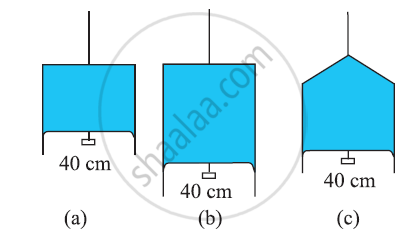
Figure (a) shows a thin liquid film supporting a small weight = 4.5 × 10⁻² N. What is the weight supported by a film of the same liquid at the same temperature in Fig. (b) and (c)? Explain your answer physically.
Define surface tension and surface energy.
Frictional force between solids operates even when they do not move with respect to each other. Do we have viscous force acting between two layers even if there is no relative motion?
If water in one flask and castor oil in other are violently shaken and kept on a table, which will come to rest earlier?
A heavy mass is attached to a thin wire and is whirled in a vertical circle. The wire is most likely to break
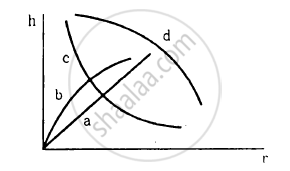
Which of the following graphs may represent the relation between the capillary rise hand the radius r of the capillary?
Viscosity is a property of
A capillary tube of radius 0.50 mm is dipped vertically in a pot of water. Find the difference between the pressure of the water in the tube 5.0 cm below the surface and the atmospheric pressure. Surface tension of water = 0.075 N m−1.
Find the surface energy of water kept in a cylindrical vessel of radius 6.0 cm. Surface tension of water = 0.075 J m−2.
A wire forming a loop is dipped into soap solution and taken out so that a film of soap solution is formed. A loop of 6.28 cm long thread is gently put on the film and the film is pricked with a needle inside the loop. The thread loop takes the shape of a circle. Find the tension the the thread. Surface tension of soap solution = 0.030 N m−1.
Water rises to a height of 20 mm in a capillary tube. If the radius made 1/3rd of its previous value, to what height will the water now rise in the tube?
A u-tube is made up of capillaries of bore 1 mm and 2 mm respectively. The tube is held vertically and partially filled with a liquid of surface tension 49 dyne/cm and zero angles of contact. Calculate the density of the liquid, if the difference in the levels of the meniscus is 1.25 cm. take g = 980 cm/s2
Describe an experiment to prove that friction depends on the nature of a surface.
Obtain an expression for the surface tension of a liquid by the capillary rise method.
If the surface tension of a soap solution is 3 × 10⁻² N/m then the work done in forming a soap film of 20 cm × 5 cm will be ______.
Is surface tension a vector?
Work done to blow a bubble of volume V is W. The work done in blowing a bubble of volume 2V will be ______.
A light metal disc of radius ‘r’ floats on water surface and bends the surface downwards along the perimeter making an angle ‘θ’ with the vertical edge of the disc. If the weight of water displaced by the disc is ‘W’, the weight of the metal disc is ______.
[T = surface tension of water]
