Advertisements
Advertisements
प्रश्न
Two mercury droplets of radii 0.1 cm. and 0.2 cm. collapse into one single drop. What amount of energy is released? The surface tension of mercury T = 435.5 × 10⁻³ Nm–1.
Advertisements
उत्तर
When two drops form a bigger drop, volume remains conserved.
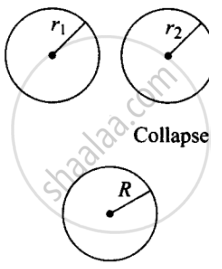
According to the problem, there is two mercury droplets of different radii collapse into one single drop.
Radius of smaller drop = r1 = 0.1 cm = 10–3 m
Radius of bigger drop = r2 = 0.2 cm = 2 × 10⁻³ m
Surface tension (T) = 435.5 × 10⁻³ N/m
Let V1 and V2 be the volumes of these two mercury droplets and the volume of big drops formed by collapsing is V.
The volume of a big drop = Volume of small droplets
`V = V_1 + V_2`
`4/3 πR^3 = 4/3 πr_1^3 + 4/3 πr_2^3`
or `R^3 = r_1^3 + r_2^3`
= (0.1)3 + (0.2)3
= 0.001 + 0.008
= 0.009
or R = 0.21 cm = 2 × 10⁻³ m
∴ Decrease in surface area,
ΔA = `4πR^2 - (4πr_1^2 + 4πr_2^2)`
= `4π[R^2 - (r_1^2 + r_2^2)]`
Energy released,
`E = T xx ΔA`
= `T xx 4π[R^2 - (r_1^2 + r_2^2)]`
= `435.5 xx 10^-3 xx 4 xx 3.14[(2.1 xx 10^-3)^2 - (1 xx 10^-6 + 4 xx 10^-6)]`
= `435.5 xx 4 xx 3.14[4.41 - 5] xx 10^-6 xx 10^-3`
= – 32.23 × 10⁻⁷ ......(Negative sign shows absorption)
Therefore, 3.22 × K–6 J energy will be absorbed. So, the surface area of the water decreases means the surface area of bigger drop is less than the sum of surface area of two smaller drops.
APPEARS IN
संबंधित प्रश्न
'n' droplets of equal size of radius r coalesce to form a bigger drop of radius R. The energy liberated is equal to...................
(T =Surface tension of water)
`(a) 4piR^2T[n^(1/3)-1]`
`(b) 4pir^2T[n^(1/3)-1]`
`(c) 4piR^2T[n^(2/3)-1]`
`(d)4 pir^2T[n^(2/3)-1]`
Explain why The angle of contact of mercury with glass is obtuse, while that of water with glass is acute
A U-shaped wire is dipped in a soap solution and removed. The thin soap film formed between the wire and the light slider supports a weight of 1.5 × 10⁻² N (which includes the small weight of the slider). The length of the slider is 30 cm. What is the surface tension of the film?
In a conical pendulum, a string of length 120 cm is fixed at rigid support and carries a mass
of 150 g at its free end. If the mass is revolved in a horizontal circle of radius 0.2 m around a
vertical axis, calculate tension in the string (g = 9.8 m/s2)
The free surface of a liquid resting in an inertial frame is horizontal. Does the normal to the free surface pass through the centre of the earth? Think separately if the liquid is (a) at the equator (b) at a pole (c) somewhere else.
Water near the bed of a deep river is quiet while that near the surface flows. Give reasons.
Air is pushed into a soap bubble of radius r to double its radius. If the surface tension of the soap solution in S, the work done in the process is
When a capillary tube is dipped into a liquid, the liquid neither rises nor falls in the capillary.
(a) The surface tension of the liquid must be zero.
(b) The contact angle must be 90°.
(c) The surface tension may be zero.
(d) The contact angle may be 90°.
Find the excess pressure inside (a) a drop of mercury of radius 2 mm (b) a soap bubble of radius 4 mm and (c) an air bubble of radius 4 mm formed inside a tank of water. Surface tension of mercury, soap solution and water are 0.465 N m−1, 0.03 N m−1 and 0.076 N m−1 respectively.
A metal piece of mass 160 g lies in equilibrium inside a glass of water. The piece touches the bottom of the glass at a small number of points. If the density of the metal is 8000 kg/m3, find the normal force exerted by the bottom of the glass on the metal piece.
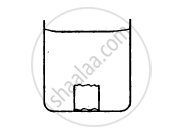
A ferry boat has internal volume 1 m3 and weight 50 kg.(a) Neglecting the thickness of the wood, find the fraction of the volume of the boat immersed in water.(b) If a leak develops in the bottom and water starts coming in, what fraction of the boat's volume will be filled with water before water starts coming in from the sides?
A cubical block of ice floating in water has to support a metal piece weighing 0.5 kg. Water can be the minimum edge of the block so that it does not sink in water? Specific gravity of ice = 0.9.
Derive an expression for capillary rise for a liquid having a concave meniscus.
Calculate the rise of water inside a clean glass capillary tube of radius 0.1 mm, when immersed in water of surface tension 7 × 10⁻² N/m. The angle of contact between water and glass is zero, the density of water = 1000 kg/m3, g = 9.8 m/s2.
Water rises to a height of 20 mm in a capillary tube. If the radius made 1/3rd of its previous value, to what height will the water now rise in the tube?
Define the surface tension of a liquid.
A spherical soap bubble A of radius 2 cm is formed inside another bubble B of radius 4 cm. Show that the radius of a single soap bubble which maintains the same pressure difference as inside the smaller and outside the larger soap bubble is lesser than the radius of both soap bubbles A and B.
What is surface tension? Explain the applications of surface tension.
Eight droplets of water each of radius 0.2 mm coalesce into a single drop. Find the decrease in the surface area.
When an air bubble of radius r rises from the bottom to the surface of a lake, its radius becomes `(5r)/4`. Taking the atmospheric pressure to be equal to the 10 m height of the water column, the depth of the lake would approximately be ______.
(ignore the surface tension and the effect of temperature)
