Advertisements
Advertisements
प्रश्न
Surface tension is exhibited by liquids due to force of attraction between molecules of the liquid. The surface tension decreases with increase in temperature and vanishes at boiling point. Given that the latent heat of vaporisation for water Lv = 540 k cal kg–1, the mechanical equivalent of heat J = 4.2 J cal–1, density of water ρw = 103 kg l–1, Avagadro’s No NA = 6.0 × 1026 k mole–1 and the molecular weight of water MA = 18 kg for 1 k mole.
- Estimate the energy required for one molecule of water to evaporate.
- Show that the inter–molecular distance for water is `d = [M_A/N_A xx 1/ρ_w]^(1/3)` and find its value.
- 1 g of water in the vapor state at 1 atm occupies 1601 cm3. Estimate the intermolecular distance at boiling point, in the vapour state.
- During vaporisation a molecule overcomes a force F, assumed constant, to go from an inter-molecular distance d to d ′. Estimate the value of F.
- Calculate F/d, which is a measure of the surface tension.
Advertisements
उत्तर
a. According to the problem, latent heat of vaporisation for water
`(L_v) = 540 k cal = 540 xx 10^3 xx 4.2 J = 2268 xx 10^3 J`
Therefore, energy required to evaporate 1 kmol (18 kg) of water
= `(2268 xx 10^3 J)(18)`
= `40824 xx 10^3 J`
= `4.0824 xx 10^7 J`
Since, there are NA molecules in MA kg of water, the energy required for 1 molecule to evaporate is
`U = (M_AL_v)/N_A J` .....[Where NA = 6 × 1026 = Avogadro number]
`U = (4.0824 xx 10^7)/(6 xx 10^26) J`
= `0.68 xx 10^-19 J`
= `6.8 xx 10^-20 J`
b. Let the water molecules to be at points and are placed at a distance d from each other,
The volume of Na molecule of water = `M_A/ρ_w`
Thus, the volume around one molecule is = `"Volume of 1 kmol"/"Number of molecules/kmol"`
= `M_A/(N_Aρ_w)`
And also volume around one molecule = d3
Thus, by equating these, we get
`d^3 = M_A/(N_Aρ_w)`
∴ `d = (M_A/(N_Aρ_w))^(1/3)`
= `(18/(6 xx 10^26 xx 10^3))^(1/3)`
= `(30 xx 10^-30)^(1/3) m`
= `3.1 xx 10^-10 m`
c. The volume occupied by 18 kg water vapour = `18 xx 1601 xx 10^-6 cm^3`
Number of molecules in 18 kg water = `6 xx 10^26`
Since `6 xx 10^26` molecules occupies `18 xx 1601 xx 10^-3 m^3`
∴ Volume occupied by 1 molecule = `(28818 xx 10^-3 m^3)/(6 xx 10^26)`
= `48030 xx 10^-30 m^3`
If d' is the intermolecular distance, then
`(d)^3 = 48030 xx 10^-30 m^3`
So, `d^' = 36.3 xx 10^-10 m = 36.3 xx 10^-10 m`
d. Work done to change the distance from d to d' is `U = F(d^' - d)`,
This work done is equal to energy required to evaporate 1 molecule.
∴ `F(d^' - d) = 6.8 xx 10^-20`
or `F = (6.8 xx 10^-20)/(d^' - d)`
= `(6.8 xx 10^-20)/((36.3 xx 10^-10 - 3.1 xx 10^-10))`
= `2.05 xx 10^-11 N`
e. Surface tension = `F/d`
= `(2.05 xx 10^-11)/(3.1 xx 10^-10)`
= `6.6 xx 10^-2` N/m
APPEARS IN
संबंधित प्रश्न
In which of the following substances, surface tension increases with increase in temperature ?
- Copper
- Molten copper
- Iron
- Molten iron
Show that the surface tension of a liquid is numerically equal to the surface energy per unit
area.
The force of surface tension acts tangentially to the surface whereas the force due to air pressure acts perpendicularly on the surface. How is then the force due to excess pressure inside a bubble balanced by the force due to the surface tension?
When the size of a soap bubble is increased by pushing more air in it, the surface area increases. Does it mean that the average separation between the surface molecules is increased?
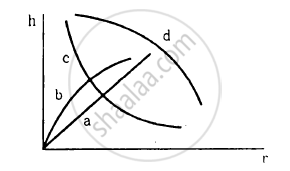
Which of the following graphs may represent the relation between the capillary rise hand the radius r of the capillary?
Find the excess pressure inside (a) a drop of mercury of radius 2 mm (b) a soap bubble of radius 4 mm and (c) an air bubble of radius 4 mm formed inside a tank of water. Surface tension of mercury, soap solution and water are 0.465 N m−1, 0.03 N m−1 and 0.076 N m−1 respectively.
A wire forming a loop is dipped into soap solution and taken out so that a film of soap solution is formed. A loop of 6.28 cm long thread is gently put on the film and the film is pricked with a needle inside the loop. The thread loop takes the shape of a circle. Find the tension the the thread. Surface tension of soap solution = 0.030 N m−1.
A ferry boat has internal volume 1 m3 and weight 50 kg.(a) Neglecting the thickness of the wood, find the fraction of the volume of the boat immersed in water.(b) If a leak develops in the bottom and water starts coming in, what fraction of the boat's volume will be filled with water before water starts coming in from the sides?
What will be the shape of the liquid meniscus for the obtuse angle of contact?
Two soap bubbles have a radius in the ratio of 2:3. Compare the works done in blowing these bubbles.
A u-tube is made up of capillaries of bore 1 mm and 2 mm respectively. The tube is held vertically and partially filled with a liquid of surface tension 49 dyne/cm and zero angles of contact. Calculate the density of the liquid, if the difference in the levels of the meniscus is 1.25 cm. take g = 980 cm/s2
The property of _______ of a liquid surface enables the water droplets to move upward in plants.
How does surface tension help a plant?
A certain number of spherical drops of a liquid of radius R coalesce to form a single drop of radius R and volume V. If T is the surface tension of the liquid, then
A drop of oil placed on the surface of water spreads out. But a drop of water place on oil contracts to a spherical shape. Why?
Obtain an expression for the surface tension of a liquid by the capillary rise method.
Two small drops of mercury each of radius 'R' coalesce to form a large single drop. The ratio of the total surface energies before and after the change is ____________.
Water rises upto a height h in a capillary tube on the surface of the earth. The value of h will increase, if the experimental setup is kept in [g = acceleration due to gravity]
What is surface tension? Explain the applications of surface tension.
If a drop of liquid breaks into smaller droplets, it results in lowering of temperature of the droplets. Let a drop of radius R, break into N small droplets each of radius r. Estimate the drop in temperature.
