Advertisements
Advertisements
Question
Surface tension is exhibited by liquids due to force of attraction between molecules of the liquid. The surface tension decreases with increase in temperature and vanishes at boiling point. Given that the latent heat of vaporisation for water Lv = 540 k cal kg–1, the mechanical equivalent of heat J = 4.2 J cal–1, density of water ρw = 103 kg l–1, Avagadro’s No NA = 6.0 × 1026 k mole–1 and the molecular weight of water MA = 18 kg for 1 k mole.
- Estimate the energy required for one molecule of water to evaporate.
- Show that the inter–molecular distance for water is `d = [M_A/N_A xx 1/ρ_w]^(1/3)` and find its value.
- 1 g of water in the vapor state at 1 atm occupies 1601 cm3. Estimate the intermolecular distance at boiling point, in the vapour state.
- During vaporisation a molecule overcomes a force F, assumed constant, to go from an inter-molecular distance d to d ′. Estimate the value of F.
- Calculate F/d, which is a measure of the surface tension.
Advertisements
Solution
a. According to the problem, latent heat of vaporisation for water
`(L_v) = 540 k cal = 540 xx 10^3 xx 4.2 J = 2268 xx 10^3 J`
Therefore, energy required to evaporate 1 kmol (18 kg) of water
= `(2268 xx 10^3 J)(18)`
= `40824 xx 10^3 J`
= `4.0824 xx 10^7 J`
Since, there are NA molecules in MA kg of water, the energy required for 1 molecule to evaporate is
`U = (M_AL_v)/N_A J` .....[Where NA = 6 × 1026 = Avogadro number]
`U = (4.0824 xx 10^7)/(6 xx 10^26) J`
= `0.68 xx 10^-19 J`
= `6.8 xx 10^-20 J`
b. Let the water molecules to be at points and are placed at a distance d from each other,
The volume of Na molecule of water = `M_A/ρ_w`
Thus, the volume around one molecule is = `"Volume of 1 kmol"/"Number of molecules/kmol"`
= `M_A/(N_Aρ_w)`
And also volume around one molecule = d3
Thus, by equating these, we get
`d^3 = M_A/(N_Aρ_w)`
∴ `d = (M_A/(N_Aρ_w))^(1/3)`
= `(18/(6 xx 10^26 xx 10^3))^(1/3)`
= `(30 xx 10^-30)^(1/3) m`
= `3.1 xx 10^-10 m`
c. The volume occupied by 18 kg water vapour = `18 xx 1601 xx 10^-6 cm^3`
Number of molecules in 18 kg water = `6 xx 10^26`
Since `6 xx 10^26` molecules occupies `18 xx 1601 xx 10^-3 m^3`
∴ Volume occupied by 1 molecule = `(28818 xx 10^-3 m^3)/(6 xx 10^26)`
= `48030 xx 10^-30 m^3`
If d' is the intermolecular distance, then
`(d)^3 = 48030 xx 10^-30 m^3`
So, `d^' = 36.3 xx 10^-10 m = 36.3 xx 10^-10 m`
d. Work done to change the distance from d to d' is `U = F(d^' - d)`,
This work done is equal to energy required to evaporate 1 molecule.
∴ `F(d^' - d) = 6.8 xx 10^-20`
or `F = (6.8 xx 10^-20)/(d^' - d)`
= `(6.8 xx 10^-20)/((36.3 xx 10^-10 - 3.1 xx 10^-10))`
= `2.05 xx 10^-11 N`
e. Surface tension = `F/d`
= `(2.05 xx 10^-11)/(3.1 xx 10^-10)`
= `6.6 xx 10^-2` N/m
APPEARS IN
RELATED QUESTIONS
Water rises to a height 3.2 cm in a glass capillary tube. Find the height to which the same water will rise in another glass capillary having half area of cross section.
'n' droplets of equal size of radius r coalesce to form a bigger drop of radius R. The energy liberated is equal to...................
(T =Surface tension of water)
`(a) 4piR^2T[n^(1/3)-1]`
`(b) 4pir^2T[n^(1/3)-1]`
`(c) 4piR^2T[n^(2/3)-1]`
`(d)4 pir^2T[n^(2/3)-1]`
What is the excess pressure inside a bubble of soap solution of radius 5.00 mm, given that the surface tension of soap solution at the temperature (20 °C) is 2.50 × 10⁻² N m–1? If an air bubble of the same dimension were formed at depth of 40.0 cm inside a container containing the soap solution (of relative density 1.20), what would be the pressure inside the bubble? (1 atmospheric pressure is 1.01 × 10⁵ Pa).
In a conical pendulum, a string of length 120 cm is fixed at rigid support and carries a mass
of 150 g at its free end. If the mass is revolved in a horizontal circle of radius 0.2 m around a
vertical axis, calculate tension in the string (g = 9.8 m/s2)
When a sparingly soluble substance like alcohol is dissolved in water, surface tension of water
A uniform vertical tube of circular cross section contains a liquid. The contact angle is 90°. Consider a diameter of the tube lying in the surface of the liquid. The surface to the right of this diameter pulls the surface on the left of it. What keeps the surface on the left in equilibrium?
If more air is pushed in a soap bubble, the pressure in it
Viscosity is a property of
A 5.0 cm long straight piece of thread is kept on the surface of water. Find the force with which the surface on one side of the thread pulls it. Surface tension of water = 0.076 N m−1.
The lower end of a capillary tube of radius 1 mm is dipped vertically into mercury. (a) Find the depression of mercury column in the capillary. (b) If the length dipped inside is half the answer of part (a), find the angle made by the mercury surface at the end of the capillary with the vertical. Surface tension of mercury = 0.465 N m−1 and the contact angle of mercury with glass −135 °.
Two large glass plates are placed vertically and parallel to each other inside a tank of water with separation between the plates equal to 1 mm. Find the rise of water in the space between the plates. Surface tension of water = 0.075 Nm−1.
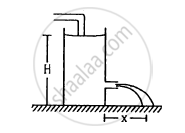
Water level is maintained in a cylindrical vessel up to a fixed height H. The vessel is kept on a horizontal plane. At what height above the bottom should a hole be made in the vessel so that the water stream coming out of the hole strikes the horizontal plane at the greatest distance from the vessel.
Why is the surface tension of paints and lubricating oils kept low?
Define the surface tension of a liquid.
What do you mean by capillarity or capillary action?
A square frame of each side L is dipped in a soap solution and taken out. The force acting on the film formed is _____.
(T = surface tension of soap solution).
If the surface tension of a soap solution is 3 × 10⁻² N/m then the work done in forming a soap film of 20 cm × 5 cm will be ______.
The sap in trees, which consists mainly of water in summer, rises in a system of capillaries of radius r = 2.5 × 10⁻⁵ m. The surface tension of sap is T = 7.28 × 10⁻² Nm–1 and the angle of contact is 0°. Does surface tension alone account for the supply of water to the top of all trees?
In most liquids, with the rise in temperature, the surface tension of a liquid ______.
