Advertisements
Advertisements
प्रश्न
Surface tension is exhibited by liquids due to force of attraction between molecules of the liquid. The surface tension decreases with increase in temperature and vanishes at boiling point. Given that the latent heat of vaporisation for water Lv = 540 k cal kg–1, the mechanical equivalent of heat J = 4.2 J cal–1, density of water ρw = 103 kg l–1, Avagadro’s No NA = 6.0 × 1026 k mole–1 and the molecular weight of water MA = 18 kg for 1 k mole.
- Estimate the energy required for one molecule of water to evaporate.
- Show that the inter–molecular distance for water is `d = [M_A/N_A xx 1/ρ_w]^(1/3)` and find its value.
- 1 g of water in the vapor state at 1 atm occupies 1601 cm3. Estimate the intermolecular distance at boiling point, in the vapour state.
- During vaporisation a molecule overcomes a force F, assumed constant, to go from an inter-molecular distance d to d ′. Estimate the value of F.
- Calculate F/d, which is a measure of the surface tension.
Advertisements
उत्तर
a. According to the problem, latent heat of vaporisation for water
`(L_v) = 540 k cal = 540 xx 10^3 xx 4.2 J = 2268 xx 10^3 J`
Therefore, energy required to evaporate 1 kmol (18 kg) of water
= `(2268 xx 10^3 J)(18)`
= `40824 xx 10^3 J`
= `4.0824 xx 10^7 J`
Since, there are NA molecules in MA kg of water, the energy required for 1 molecule to evaporate is
`U = (M_AL_v)/N_A J` .....[Where NA = 6 × 1026 = Avogadro number]
`U = (4.0824 xx 10^7)/(6 xx 10^26) J`
= `0.68 xx 10^-19 J`
= `6.8 xx 10^-20 J`
b. Let the water molecules to be at points and are placed at a distance d from each other,
The volume of Na molecule of water = `M_A/ρ_w`
Thus, the volume around one molecule is = `"Volume of 1 kmol"/"Number of molecules/kmol"`
= `M_A/(N_Aρ_w)`
And also volume around one molecule = d3
Thus, by equating these, we get
`d^3 = M_A/(N_Aρ_w)`
∴ `d = (M_A/(N_Aρ_w))^(1/3)`
= `(18/(6 xx 10^26 xx 10^3))^(1/3)`
= `(30 xx 10^-30)^(1/3) m`
= `3.1 xx 10^-10 m`
c. The volume occupied by 18 kg water vapour = `18 xx 1601 xx 10^-6 cm^3`
Number of molecules in 18 kg water = `6 xx 10^26`
Since `6 xx 10^26` molecules occupies `18 xx 1601 xx 10^-3 m^3`
∴ Volume occupied by 1 molecule = `(28818 xx 10^-3 m^3)/(6 xx 10^26)`
= `48030 xx 10^-30 m^3`
If d' is the intermolecular distance, then
`(d)^3 = 48030 xx 10^-30 m^3`
So, `d^' = 36.3 xx 10^-10 m = 36.3 xx 10^-10 m`
d. Work done to change the distance from d to d' is `U = F(d^' - d)`,
This work done is equal to energy required to evaporate 1 molecule.
∴ `F(d^' - d) = 6.8 xx 10^-20`
or `F = (6.8 xx 10^-20)/(d^' - d)`
= `(6.8 xx 10^-20)/((36.3 xx 10^-10 - 3.1 xx 10^-10))`
= `2.05 xx 10^-11 N`
e. Surface tension = `F/d`
= `(2.05 xx 10^-11)/(3.1 xx 10^-10)`
= `6.6 xx 10^-2` N/m
APPEARS IN
संबंधित प्रश्न
The energy of the free surface of a liquid drop is 5π times the surface tension of the liquid. Find the diameter of the drop in C.G.S. system.
Define the angle of contact.
Explain why Water with detergent dissolved in it should have small angles of contact.
Fill in the blanks using the word(s) from the list appended with each statement
Surface tension of liquids generally . . . with temperatures (increases / decreases)
A U-shaped wire is dipped in a soap solution and removed. The thin soap film formed between the wire and the light slider supports a weight of 1.5 × 10⁻² N (which includes the small weight of the slider). The length of the slider is 30 cm. What is the surface tension of the film?
When the size of a soap bubble is increased by pushing more air in it, the surface area increases. Does it mean that the average separation between the surface molecules is increased?
If more air is pushed in a soap bubble, the pressure in it
The contact angle between a solid and a liquid is a property of
(a) the material of the solid
(b) the material of the liquid
(c) the shape of the solid
(d) the mass of the solid
A cubical block of wood weighing 200 g has a lead piece fastened underneath. Find the mass of the lead piece which will just allow the block to float in water. Specific gravity of wood is 0.8 and that of lead is 11.3.
Solve the previous problem if the lead piece is fastened on the top surface of the block and the block is to float with its upper surface just dipping into water.
Explain the capillary action.
Insect moves over the surface of water because of ______.
Define the angle of contact for a given pair of solid and liquid.
A square frame of each side L is dipped in a soap solution and taken out. The force acting on the film formed is _____.
(T = surface tension of soap solution).
What is surface tension? Explain the applications of surface tension.
Is surface tension a vector?
A coaxial cylinder made of glass is immersed in liquid of surface tension ' S'. Radius of inner and outer surface of cylinder are R1 and R2 respectively. Height till which liquid will rise is (Density of liquid is p):
In a U-tube, the radii of two columns are respectively r1 and r2. When a liquid of density ρ(θ = 0°) is filled in it, a level difference of h is observed on two arms, then the surface tension of the liquid is ______.
When an air bubble of radius r rises from the bottom to the surface of a lake, its radius becomes `(5r)/4`. Taking the atmospheric pressure to be equal to the 10 m height of the water column, the depth of the lake would approximately be ______.
(ignore the surface tension and the effect of temperature)
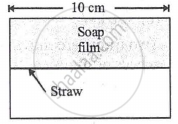
A soap film of surface tension 3 × 10⁻² formed in a rectangular frame can support a straw as shown in Fig. If g = 10 ms-12, the mass of the straw is ______.