Advertisements
Advertisements
प्रश्न
A solid sphere of radius 5 cm floats in water. If a maximum load of 0.1 kg can be put on it without wetting the load, find the specific gravity of the material of the sphere.
Advertisements
उत्तर
Given:
Radius of the sphere, r = 5 cm
Mass of the maximum load, m = 0.1 kg
Let the weight of the sphere be W1 and the weight of the load be W2.
Now,
W1 + W2 = U
Here, U is the upward thrust.
Let V be the volume of the sphere.
\[\text{ Thus, we have: } \]
\[\text{mg + V }\times \rho_\text{s} \times \text{g = v } \times \rho_\text{w } \times \text{g}\]
\[\text{Here, }\]
\[ \rho_\text{ s }=\text{ Density of the sphere in gm/cc }\]
\[ \rho_\text{w }=\text{ Density of water }\]
\[\text{ On substituting the respective values in the above equation, we get: } \]
\[ (0 . 1) \times {10}^3 + \left( \frac{4}{3} \right) \times \pi \times (5 )^3 \times \rho_s = \left( \frac{4}{3} \right) \times \pi \times (5 )^3 \times 1\]
\[ \Rightarrow 100 = \left( \frac{4}{3} \right) \times \pi \times 125 \times (1 - \rho_\text{s} )\]
\[ \Rightarrow 1 - \rho_\text{s} = \frac{3 \times 100}{4 \times \pi \times 125} = 0 . 19\]
\[ \Rightarrow \rho_\text{s} = 1 - (0 . 19)\]
\[ = 0 . 81 \text{ gm/cc = 0 . 8 gm/cc}\]
APPEARS IN
संबंधित प्रश्न
If more air is pushed in a soap bubble, the pressure in it
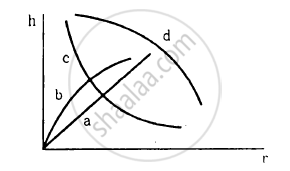
Which of the following graphs may represent the relation between the capillary rise hand the radius r of the capillary?
A capillary tube of radius 1 mm is kept vertical with the lower end in water. (a) Find the height of water raised in the capillary. (b) If the length of the capillary tube is half the answer of part , find the angle θ made by the water surface in the capillary with the wall.
The lower end of a capillary tube of radius 1 mm is dipped vertically into mercury. (a) Find the depression of mercury column in the capillary. (b) If the length dipped inside is half the answer of part (a), find the angle made by the mercury surface at the end of the capillary with the vertical. Surface tension of mercury = 0.465 N m−1 and the contact angle of mercury with glass −135 °.
A wire forming a loop is dipped into soap solution and taken out so that a film of soap solution is formed. A loop of 6.28 cm long thread is gently put on the film and the film is pricked with a needle inside the loop. The thread loop takes the shape of a circle. Find the tension the the thread. Surface tension of soap solution = 0.030 N m−1.
Find the force exerted by the water on a 2 m2 plane surface of a large stone placed at the bottom of a sea 500 m deep. Does the force depend on the orientation of the surface?
A cubical block of ice floating in water has to support a metal piece weighing 0.5 kg. Water can be the minimum edge of the block so that it does not sink in water? Specific gravity of ice = 0.9.
A cubical box is to be constructed with iron sheets 1 mm in thickness. What can be the minimum value of the external edge so that the cube does not sink in water? Density of iron = 8000 kg/m3 and density of water = 1000 kg/m3.
A cubical block of wood weighing 200 g has a lead piece fastened underneath. Find the mass of the lead piece which will just allow the block to float in water. Specific gravity of wood is 0.8 and that of lead is 11.3.
A drop of mercury of radius 0.2 cm is broken into 8 droplets of the same size. Find the work done if the surface tension of mercury is 435.5 dyn/cm.
What will be the shape of the liquid meniscus for the obtuse angle of contact?
Water rises to a height of 20 mm in a capillary tube. If the radius made 1/3rd of its previous value, to what height will the water now rise in the tube?
Obtain an expression for the capillary rise or fall using the forces method.
Define the surface tension of a liquid.
Obtain an expression for the surface tension of a liquid by the capillary rise method.
A spherical soap bubble A of radius 2 cm is formed inside another bubble B of radius 4 cm. Show that the radius of a single soap bubble which maintains the same pressure difference as inside the smaller and outside the larger soap bubble is lesser than the radius of both soap bubbles A and B.
Why coffee runs up into a sugar lump (a small cube of sugar) when one corner of the sugar lump is held in the liquid?
What is surface tension? Explain the applications of surface tension.
For a surface molecule ______.
- the net force on it is zero.
- there is a net downward force.
- the potential energy is less than that of a molecule inside.
- the potential energy is more than that of a molecule inside.
Is surface tension a vector?
