Advertisements
Advertisements
प्रश्न
A hot air balloon is a sphere of radius 8 m. The air inside is at a temperature of 60°C. How large a mass can the balloon lift when the outside temperature is 20°C? (Assume air is an ideal gas, R = 8.314 J mole–1K–1, 1 atm. = 1.013 × 10⁵ Pa; the membrane tension is 5 Nm–1.)
Advertisements
उत्तर
The pressure inside `P_i` balloon is larger than the outer pressure `P_a` of the atmosphere.
∴ `P_c = P_a = (2σ)/R`
σ = surface tension in the membrane of balloon R = radius of the balloon.
Gas or air inside is perfect (considered)
∴ `PV = n_iRT_i`
`V` = volume of the balloon
`n_c` = no. of moles of gas in the balloon
`R` = gas constant
`T_i` = temperature of balloon
`n_i = (PV)/(RT_i) = "mass of balloon (M)"/("molecular mass" (M_A))`
`n_i = M_1/M_A = (PV)/(RT_i)`
Similarly, `n_a = (P_aV)/(RT_a)`
By principal off floatation `W + M, g = Mσg`
W = weight lifted by balloon `W = M_ag - M_ig`
W = `(M_a - M_i)g`
Where `n_a` = no. of molecules of air displaced by balloon.
V = volume of air displaced by balloon equal to the volume of balloon If `M_a` mass of air displaced by the balloon
`M_A` = molecular mass inside or outside the balloon
∴ `n_σ = M_a/M_A`
`n_o = M_a/M_A = (P_oV)/(RT_a)`
⇒ `M_a = (P_aVM_A)/(RT_o)`
From (i), `M_i = (P_iVM_A)/(RT_i)`
W = `((P_0VM_A)/(RT_a) - (PVM_A)/(RT_i))g`
w = `(VM_A)/R (P_a/T_a - P_c/T_i)g`
`M_A = 21%` of `O_2 + 79%` of `N_2`
`M_A = 0.21 xx 32 + 0.79 xx 28`
`M_A = 4(0.21 xx 8 + 0.79 xx 7)`
`M_A = 4(1.68 + 5.53)`
`M_A = 4(7.21)`
`M_A = 28.84 g`
`M_A = 0.2884 kg`
`P_i = P_σ + (2σ)/R`
W = `4/3 pi xx 8 xx 8 xx 8 xx 0.2884`
= `[(1.013 xx 10^5)/(273 + 20) - P_i/(273 + 60)]g`
`P_i = P_a + P = P_a + (2σ)/R`
`P_i = [1.013 xx 10^5 + (2 xx 5)/8] = 101300 + 1.25`
`P_i = 101301.25 = 1.0130125 xx 10^5 = 1.013 xx 10^5`
∴ W = `(4 xx 3.14 xx 8 xx 8 xx 8 xx 0.02884)/(3 xx 8.314) [(1.013 xx 10^5)/293 - (1.013 xx 10^5)/333]g`
W = `(4 xx 3.14 xx 8 xx 8 xx 8 xx 0.02884 xx 1.013 xx 10^5)/(3 xx 8.314) [1/293 -1/333]g`
W = `(4 xx 3.14 xx 8 xx 8 xx 8 xx 0.02884 xx 1.013 xx 10^5 xx 9.8)/(3 xx 8.314) [1/293 -1/333]`
W =
`(4 xx 3.14 xx 8 xx 8 xx 8 xx 0.02884 xx 1.013 xx 10^5 xx 9.8 xx 40)/(3 xx 8.314)`
= 3044.2 N
APPEARS IN
संबंधित प्रश्न
Explain why Surface tension of a liquid is independent of the area of the surface
A body weighs 4.0 kg-wt on the surface of the Earth. What will be its weight on the surface of a plant whose mass is `1/8` th of the mass of the Earth and radius half `(1/2)` of that of the Earth?
If two soap bubbles of different radii are connected by a tube,
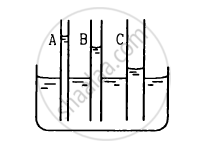
The capillaries shown in figure have inner radii 0.5 mm, 1.0 mm and 1.5 mm respectively. The liquid in the beaker is water. Find the heights of water level in the capillaries. The surface tension of water is 7.5 × 10⁻² N m−1.
A barometer is constructed with its tube having radius 1.0 mm. Assume that the surface of mercury in the tube is spherical in shape. If the atmospheric pressure is equal to 76 cm of mercury, what will be the height raised in the barometer tube? The contact angle of mercury with glass = 135° and surface tension of mercury = 0.465 N m−1. Density of mercury = 13600 kg m−3.
Explain the capillary action.
Obtain an expression for the capillary rise or fall using the forces method.
A certain number of spherical drops of a liquid of radius R coalesce to form a single drop of radius R and volume V. If T is the surface tension of the liquid, then
The wettability of a surface by a liquid depends primarily on
Why coffee runs up into a sugar lump (a small cube of sugar) when one corner of the sugar lump is held in the liquid?
Two spherical rain drops reach the surface of the earth with terminal velocities having ratio 16 : 9. The ratio of their surface area is ______.
Water rises upto a height h in a capillary tube on the surface of the earth. The value of h will increase, if the experimental setup is kept in [g = acceleration due to gravity]
A water drop of radius R' splits into 'n' smaller drops, each of radius 'r'. The work done in the process is ______.
T = surface tension of water
The wear and tear in the machine part is due to ______.
The angle of contact at the interface of water-glass is 0°, Ethylalcohol-glass is 0°, Mercury-glass is 140° and Methyliodide-glass is 30°. A glass capillary is put in a trough containing one of these four liquids. It is observed that the meniscus is convex. The liquid in the trough is ______.
The sufrace tension and vapour pressure of water at 20°C is 7.28 × 10⁻² Nm–1 and 2.33 × 10³ Pa, respectively. What is the radius of the smallest spherical water droplet which can form without evaporating at 20°C?
Two blocks of masses m and M are connected by means of a metal wire of cross-sectional area A passing over a frictionless fixed pully as shown in the figure. The system is then released. If M = 2m, then the stress produced in the wire is ______.

In most liquids, with the rise in temperature, the surface tension of a liquid ______.
A light metal disc of radius ‘r’ floats on water surface and bends the surface downwards along the perimeter making an angle ‘θ’ with the vertical edge of the disc. If the weight of water displaced by the disc is ‘W’, the weight of the metal disc is ______.
[T = surface tension of water]
