Advertisements
Advertisements
प्रश्न
Derive Laplace’s law for spherical membrane of bubble due to surface tension.
Derive Laplace’s law for a spherical membrane.
Advertisements
उत्तर १
Consider a spherical liquid drop and let the outside pressure be Po and inside pressure be Pi, such that the excess pressure is Pi − Po
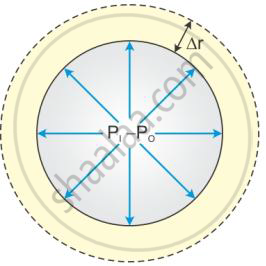
Let the radius of the drop increase from r to Δr, where Δr is very small, so that the pressure inside the drop remains almost constant.
Initial surface area (A1) = 4Πr2
Final surface area (A2) = 4Π(r + Δr)2
= 4π(r2 + 2rΔr + Δr2)
= 4Πr2 + 8ΠrΔr + 4ΠΔr2
As Δr is very small, Δr2 is neglected (i.e. 4πΔr2≅0)
Increase in surface area (dA) =A2 - A1= 4Πr2 + 8ΠrΔr - 4Πr2
Increase in surface area (dA) =8ΠΔr
Work done to increase the surface area by 8ΠrΔr is extra energy.
∴ dW = TdA
∴ dW = T*8πrΔr .......(Equ.1)
This work done is equal to the product of the force and the distance Δr.
dF=(P1 - P0)4πr2
The increase in the radius of the bubble is Δr.
dW = dFΔr = (P1 - P0)4Πr2*Δr ..........(Equ.2)
Comparing Equations 1 and 2, we get
(P1 - P0)4πr2*Δr = T*8πrΔr
∴`(P_1 - P_0) = (2T)/R`
This is called Laplace’s law of spherical membrane.
उत्तर २
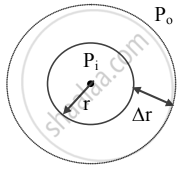
- The free surface of drops or bubbles is spherical in shape.
Let,
Pi = inside pressure of a drop or air bubble
Po = outside pressure of the bubble
r = radius of drop or bubble. - As drop is spherical, Pi > Po
∴ excess pressure inside drop = Pi − Po - Let the radius of drop increase from r to r + ∆r so that inside pressure remains constant.
- Initial area of drop A1 = 4πr2 ,
Final surface area of drop A2 = 4π (r + ∆r)2
Increase in surface area,
∆A = A2 − A1 = 4π[(r + ∆r)2 − r2]
= 4π[r2 + 2r∆r + ∆r2 − r2]
= 8πr∆r + 4π∆r2 - As ∆r is very small, the term containing ∆r2 can be neglected.
∴ dA = 8πr∆r - Work is done by a force of surface tension,
dW = TdA = (8πr∆r)T ….(1)
This work done is also equal to the product of the force F which causes an increase in the area of the bubble and the displacement Δr which is the increase in the radius of the bubble.
∴ dW = FΔr
The excess force is given by,
(Excess pressure) × (Surface area)
∴ F = (Pi – Po) × 4πr2
∴ dF = (Pi – Po)A
dW = F∆r = (Pi − Po) A∆r
From equation (1),
(Pi − Po) A∆r = (8πr∆r) T
∴ Pi − Po = `(8pirDeltarT)/(4pir^2Deltar)` ........(∵ A = 4πr2)
∴ Pi − Po = `(2T)/r` ….(2)
Equation (2) represents Laplace’s law of spherical membrane.
APPEARS IN
संबंधित प्रश्न
The energy of the free surface of a liquid drop is 5π times the surface tension of the liquid. Find the diameter of the drop in C.G.S. system.
The surface tension of water at 0°C is 75.5 dyne/cm. Calculate surface tension of water at 25°C.
(α for water = 2.7×10⁻³/°C)
Derive an expression for excess pressure inside a drop of liquid.
Water rises to a height 3.2 cm in a glass capillary tube. Find the height to which the same water will rise in another glass capillary having half area of cross section.
In which of the following substances, surface tension increases with increase in temperature ?
- Copper
- Molten copper
- Iron
- Molten iron
Explain why The angle of contact of mercury with glass is obtuse, while that of water with glass is acute
A U-shaped wire is dipped in a soap solution and removed. The thin soap film formed between the wire and the light slider supports a weight of 1.5 × 10⁻² N (which includes the small weight of the slider). The length of the slider is 30 cm. What is the surface tension of the film?
A big drop of radius R is formed from 1000 droplets of water. The radius of a droplet will be _______
A) 10 R
B) R/10
C) R/100
D) R/1000
State any two characteristics of the angle of contact
It is said that a liquid rises or is depressed in capillary due to the surface tension. If a liquid neither rises nor depresses in a capillary, can we conclude that the surface tension of the liquid is zero?
If a mosquito is dipped into water and released, it is not able to fly till it is dry again. Explain
A heavy mass is attached to a thin wire and is whirled in a vertical circle. The wire is most likely to break
An ice cube is suspended in vacuum in a gravity free hall. As the ice melts it
When water droplets merge to form a bigger drop
Air is pushed into a soap bubble of radius r to double its radius. If the surface tension of the soap solution in S, the work done in the process is
If more air is pushed in a soap bubble, the pressure in it
Water rises in a vertical capillary tube up to a length of 10 cm. If the tube is inclined at 45°, the length of water risen in the tube will be
A 20 cm long capillary tube is dipped in water. The water rises up to 8 cm. If the entire arrangement is put in a freely falling elevator, the length of water column in the capillary tube will be
The rise of a liquid in a capillary tube depends on
(a) the material
(b) the length
(c) the outer radius
(d) the inner radius of the tube
When a capillary tube is dipped into a liquid, the liquid neither rises nor falls in the capillary.
(a) The surface tension of the liquid must be zero.
(b) The contact angle must be 90°.
(c) The surface tension may be zero.
(d) The contact angle may be 90°.
Consider a small surface area of 1 mm2 at the top of a mercury drop of radius 4.0 mm. Find the force exerted on this area (a) by the air above it (b) by the mercury below it and (c) by the mercury surface in contact with it. Atmospheric pressure = 1.0 × 10⁵ Pa and surface tension of mercury = 0.465 N m−1. Neglect the effect of gravity. Assume all numbers to be exact.
A drop of mercury of radius 2 mm is split into 8 identical droplets. Find the increase in surface energy. Surface tension of mercury = 0.465 J m−2.
A wire forming a loop is dipped into soap solution and taken out so that a film of soap solution is formed. A loop of 6.28 cm long thread is gently put on the film and the film is pricked with a needle inside the loop. The thread loop takes the shape of a circle. Find the tension the the thread. Surface tension of soap solution = 0.030 N m−1.
A ferry boat has internal volume 1 m3 and weight 50 kg.(a) Neglecting the thickness of the wood, find the fraction of the volume of the boat immersed in water.(b) If a leak develops in the bottom and water starts coming in, what fraction of the boat's volume will be filled with water before water starts coming in from the sides?
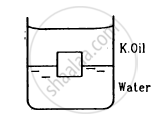
A cube of ice floats partly in water and partly in K.oil (in the following figure). Find the ratio of the volume of ice immersed in water to that in K.oil. Specific gravity of K.oil is 0.8 and that of ice is 0.9.
A cubical block of wood weighing 200 g has a lead piece fastened underneath. Find the mass of the lead piece which will just allow the block to float in water. Specific gravity of wood is 0.8 and that of lead is 11.3.
A solid sphere of radius 5 cm floats in water. If a maximum load of 0.1 kg can be put on it without wetting the load, find the specific gravity of the material of the sphere.
How much amount of work is done in forming a soap bubble of radius r?
Derive an expression for capillary rise for a liquid having a concave meniscus.
The surface tension of a liquid at critical temperature is ______
Explain the phenomena of surface tension on the basis of molecular theory.
The property of _______ of a liquid surface enables the water droplets to move upward in plants.
How does the friction arise between the surfaces of two bodies in relative motion?
Describe an experiment to prove that friction depends on the nature of a surface.
Define the surface tension of a liquid.
How is surface tension related to surface energy?
Distinguish between cohesive and adhesive forces.
What do you mean by capillarity or capillary action?
What is capillarity?
A spherical soap bubble A of radius 2 cm is formed inside another bubble B of radius 4 cm. Show that the radius of a single soap bubble which maintains the same pressure difference as inside the smaller and outside the larger soap bubble is lesser than the radius of both soap bubbles A and B.
The surface tension of the two liquids is respectively 20 and 60 dyne cm-1. The liquids drop from the ends of two tubes of the same radius. The ratio of the weights of the two drops is ______
A square frame of each side L is dipped in a soap solution and taken out. The force acting on the film formed is _____.
(T = surface tension of soap solution).
Two spherical rain drops reach the surface of the earth with terminal velocities having ratio 16 : 9. The ratio of their surface area is ______.
Water rises upto a height h in a capillary tube on the surface of the earth. The value of h will increase, if the experimental setup is kept in [g = acceleration due to gravity]
If the surface tension of a soap solution is 3 × 10⁻² N/m then the work done in forming a soap film of 20 cm × 5 cm will be ______.
Is surface tension a vector?
This model of the atmosphere works for relatively small distances. Identify the underlying assumption that limits the model.
A coaxial cylinder made of glass is immersed in liquid of surface tension ' S'. Radius of inner and outer surface of cylinder are R1 and R2 respectively. Height till which liquid will rise is (Density of liquid is p):
Work done to blow a bubble of volume V is W. The work done in blowing a bubble of volume 2V will be ______.
