Advertisements
Advertisements
प्रश्न
Consider an ice cube of edge 1.0 cm kept in a gravity-free hall. Find the surface area of the water when the ice melts. Neglect the difference in densities of ice and water.
Advertisements
उत्तर
Given:
Edge of the ice cube (a) = 1.0 cm
The water that is formed due to the melting of ice acquires a spherical surface.
In the absence of gravity, let the radius of the spherical surface be r.
Volume of ice cube = volume of spherical surface of water
\[\Rightarrow a^3 = \frac{4}{3}\pi r^3 \]
\[ \Rightarrow r = \left[ \frac{3 a^3}{4\pi} \right]^{1/3}\]
Surface area of spherical water surface = 4πr2
\[= 4\pi \left[ \frac{3 a^3}{4\pi} \right]^{2/3} \]
\[ = \left( 36\pi \right)^{1/3} {\text{ cm }}^2\]
APPEARS IN
संबंधित प्रश्न
The surface tension of water at 0°C is 75.5 dyne/cm. Calculate surface tension of water at 25°C.
(α for water = 2.7×10⁻³/°C)
Angle of contact for the pair of pure water with clean glass is _______.
The surface tension of water at 0ºc is 75·5 dyne/cm. Find surface tension of water at 25°C. [ α for water = 0·0021/°C ]
Two narrow bores of diameters 3.0 mm and 6.0 mm are joined together to form a U-tube open at both ends. If the U-tube contains water, what is the difference in its levels in the two limbs of the tube? Surface tension of water at the temperature of the experiment is 7.3 × 10⁻² N m–1. Take the angle of contact to be zero and density of water to be 1.0 × 10³ kg m–3 (g = 9.8 m s–2)
State any two characteristics of the angle of contact
It is said that a liquid rises or is depressed in capillary due to the surface tension. If a liquid neither rises nor depresses in a capillary, can we conclude that the surface tension of the liquid is zero?
An ice cube is suspended in vacuum in a gravity free hall. As the ice melts it
Which of the following graphs may represent the relation between the capillary rise hand the radius r of the capillary?
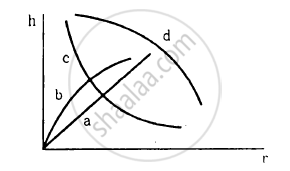
When a capillary tube is dipped into a liquid, the liquid neither rises nor falls in the capillary.
(a) The surface tension of the liquid must be zero.
(b) The contact angle must be 90°.
(c) The surface tension may be zero.
(d) The contact angle may be 90°.
Find the surface energy of water kept in a cylindrical vessel of radius 6.0 cm. Surface tension of water = 0.075 J m−2.
A ferry boat has internal volume 1 m3 and weight 50 kg.(a) Neglecting the thickness of the wood, find the fraction of the volume of the boat immersed in water.(b) If a leak develops in the bottom and water starts coming in, what fraction of the boat's volume will be filled with water before water starts coming in from the sides?
A cubical block of ice floating in water has to support a metal piece weighing 0.5 kg. Water can be the minimum edge of the block so that it does not sink in water? Specific gravity of ice = 0.9.
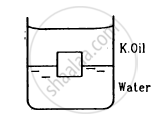
A cube of ice floats partly in water and partly in K.oil (in the following figure). Find the ratio of the volume of ice immersed in water to that in K.oil. Specific gravity of K.oil is 0.8 and that of ice is 0.9.
Calculate the rise of water inside a clean glass capillary tube of radius 0.1 mm, when immersed in water of surface tension 7 × 10⁻² N/m. The angle of contact between water and glass is zero, the density of water = 1000 kg/m3, g = 9.8 m/s2.
Numerical Problem.
A stone weighs 500 N. Calculate the pressure exerted by it if it makes contact with a surface of area 25 cm2.
Explain elasticity using intermolecular forces.
Mention the S.I unit and dimension of surface tension.
What is capillarity?
What is surface tension? Explain the applications of surface tension.
