Advertisements
Advertisements
प्रश्न
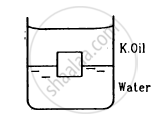
A cube of ice floats partly in water and partly in K.oil (in the following figure). Find the ratio of the volume of ice immersed in water to that in K.oil. Specific gravity of K.oil is 0.8 and that of ice is 0.9.
Advertisements
उत्तर
Given:
Specific gravity of water, \[\rho_W\] = 1 gm/cc
Specific gravity of ice, ρice = 0.9 gm/cc
Specific gravity of kerosene oil, ρk = 0.8 gm/cc
Now,
Vice = Vk + Vw
Here,
Vk = Volume of ice inside kerosene oil
Vw = Volume of ice inside water
Vice = Volume of ice
Thus, we have:
\[V_{ice} \times \rho_{ice} \times g = V_k \times \rho_k \times g + V_w \times \rho_w \times g\]
\[ \Rightarrow \left( V_k + V_w \right) \times \rho_{ice} = V_k \times \rho_k + V_w \times \rho_w \]
\[ \Rightarrow (0 . 9) V_k + (0 . 9) V_w = (0 . 8) V_k + \left( 1 \right) \times V_w \]
\[ \Rightarrow (0 . 1) V_w = 0 . 1 V_k \]
\[ \Rightarrow \frac{V_w}{V_k} = 1 . \]
\[ \Rightarrow V_w : V_k = 1: 1\]
APPEARS IN
संबंधित प्रश्न
Angle of contact for the pair of pure water with clean glass is _______.
Draw a neat labelled diagram showing forces acting on the meniscus of water in a capillary tube.
In which of the following substances, surface tension increases with increase in temperature ?
- Copper
- Molten copper
- Iron
- Molten iron
Explain why Surface tension of a liquid is independent of the area of the surface
If a mosquito is dipped into water and released, it is not able to fly till it is dry again. Explain
A heavy mass is attached to a thin wire and is whirled in a vertical circle. The wire is most likely to break
An ice cube is suspended in vacuum in a gravity free hall. As the ice melts it
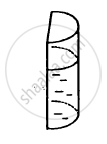
A liquid is contained in a vertical tube of semicircular cross section. The contact angle is zero. The force of surface tension on the curved part and on the flat part are in ratio
When a capillary tube is dipped into a liquid, the liquid neither rises nor falls in the capillary.
(a) The surface tension of the liquid must be zero.
(b) The contact angle must be 90°.
(c) The surface tension may be zero.
(d) The contact angle may be 90°.
The lower end of a capillary tube of radius 1 mm is dipped vertically into mercury. (a) Find the depression of mercury column in the capillary. (b) If the length dipped inside is half the answer of part (a), find the angle made by the mercury surface at the end of the capillary with the vertical. Surface tension of mercury = 0.465 N m−1 and the contact angle of mercury with glass −135 °.
A wire forming a loop is dipped into soap solution and taken out so that a film of soap solution is formed. A loop of 6.28 cm long thread is gently put on the film and the film is pricked with a needle inside the loop. The thread loop takes the shape of a circle. Find the tension the the thread. Surface tension of soap solution = 0.030 N m−1.
Find the force exerted by the water on a 2 m2 plane surface of a large stone placed at the bottom of a sea 500 m deep. Does the force depend on the orientation of the surface?
The property of _______ of a liquid surface enables the water droplets to move upward in plants.
What do you mean by capillarity or capillary action?
The surface tension of the two liquids is respectively 20 and 60 dyne cm-1. The liquids drop from the ends of two tubes of the same radius. The ratio of the weights of the two drops is ______
What is surface tension? Explain the applications of surface tension.
For a surface molecule ______.
- the net force on it is zero.
- there is a net downward force.
- the potential energy is less than that of a molecule inside.
- the potential energy is more than that of a molecule inside.
Work done to blow a bubble of volume V is W. The work done in blowing a bubble of volume 2V will be ______.
Define angle of contact.
