Advertisements
Advertisements
Question
Two narrow bores of diameters 3.0 mm and 6.0 mm are joined together to form a U-tube open at both ends. If the U-tube contains water, what is the difference in its levels in the two limbs of the tube? Surface tension of water at the temperature of the experiment is 7.3 × 10⁻² N m–1. Take the angle of contact to be zero and density of water to be 1.0 × 10³ kg m–3 (g = 9.8 m s–2)
Advertisements
Solution
Diameter of the first bore, d1 = 3.0 mm = 3 × 10⁻³ m
Hence the radius of the first bore, `r_1 = d_1/2 = 1.5 xx 10^(-3) m`
Diameter of the second bore, `d_2`= 6.0 mm
Hence the radius of the second bore, `r_2 = d_2/2 = 3xx 10^(-3) m`
Surface tension of water `s = 7.3 xx 10^(-2) Nm^(-1)`
Angle of contact between the bore surface and water, θ= 0
Density of water, ρ =1.0 × 10³ kg/m–3
Acceleration due to gravity, g = 9.8 m/s2
Let h1 and h2 be the heights to which water rises in the first and second tubes respectively. These heights are given by the relations:
`h_1 = (2s cos theta)/(r_1rhog)` ...(i)
`h_2 = (2scos theta)/(r_2rhog)` ...(ii)
The difference between the levels of water in the two limbs of the tube can be calculated as:
`= (2 s cos theta)/(r_1rhog) - (2 s cos theta)/(r_2rhog)`
`= (2 s cos theta)/(rhog)[1/r_1 - 1/r_2]`
`= (2xx 7.3 xx 10^(-2) xx 1)/(1xx10^3xx9.8) [1/(1.5xx10^(-3)) - 1/(3xx10^(-3))]`
`= 4.966 xx 10^(-3) m`
= 4.97 mm
Hence, the difference between levels of water in the two bores is 4.97 mm.
APPEARS IN
RELATED QUESTIONS
It is said that a liquid rises or is depressed in capillary due to the surface tension. If a liquid neither rises nor depresses in a capillary, can we conclude that the surface tension of the liquid is zero?
A uniform vertical tube of circular cross section contains a liquid. The contact angle is 90°. Consider a diameter of the tube lying in the surface of the liquid. The surface to the right of this diameter pulls the surface on the left of it. What keeps the surface on the left in equilibrium?
Water near the bed of a deep river is quiet while that near the surface flows. Give reasons.
If water in one flask and castor oil in other are violently shaken and kept on a table, which will come to rest earlier?
When water droplets merge to form a bigger drop
A 5.0 cm long straight piece of thread is kept on the surface of water. Find the force with which the surface on one side of the thread pulls it. Surface tension of water = 0.076 N m−1.
Two large glass plates are placed vertically and parallel to each other inside a tank of water with separation between the plates equal to 1 mm. Find the rise of water in the space between the plates. Surface tension of water = 0.075 Nm−1.
A cubical block of ice floating in water has to support a metal piece weighing 0.5 kg. Water can be the minimum edge of the block so that it does not sink in water? Specific gravity of ice = 0.9.
Derive an expression for capillary rise for a liquid having a concave meniscus.
How is surface tension related to surface energy?
Distinguish between cohesive and adhesive forces.
What are the factors affecting the surface tension of a liquid?
What is capillarity?
If the surface tension of a soap solution is 3 × 10⁻² N/m then the work done in forming a soap film of 20 cm × 5 cm will be ______.
What is surface tension? Explain the applications of surface tension.
The free surface of oil in a tanker, at rest, is horizontal. If the tanker starts accelerating the free surface will be titled by an angle θ. If the acceleration is a ms–2, what will be the slope of the free surface?
Two mercury droplets of radii 0.1 cm. and 0.2 cm. collapse into one single drop. What amount of energy is released? The surface tension of mercury T = 435.5 × 10⁻³ Nm–1.
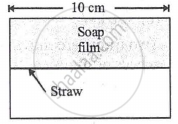
A soap film of surface tension 3 × 10⁻² formed in a rectangular frame can support a straw as shown in Fig. If g = 10 ms-12, the mass of the straw is ______.
The surface tension of a soap solution is T. The work done in blowing a soap bubble of diameter d to that of a diameter 2d is ______.
A drop of water of radius 8 mm breaks into number of droplets each of radius 1 mm. How many droplets will be formed?
