Advertisements
Advertisements
प्रश्न
Two narrow bores of diameters 3.0 mm and 6.0 mm are joined together to form a U-tube open at both ends. If the U-tube contains water, what is the difference in its levels in the two limbs of the tube? Surface tension of water at the temperature of the experiment is 7.3 × 10⁻² N m–1. Take the angle of contact to be zero and density of water to be 1.0 × 10³ kg m–3 (g = 9.8 m s–2)
Advertisements
उत्तर
Diameter of the first bore, d1 = 3.0 mm = 3 × 10⁻³ m
Hence the radius of the first bore, `r_1 = d_1/2 = 1.5 xx 10^(-3) m`
Diameter of the second bore, `d_2`= 6.0 mm
Hence the radius of the second bore, `r_2 = d_2/2 = 3xx 10^(-3) m`
Surface tension of water `s = 7.3 xx 10^(-2) Nm^(-1)`
Angle of contact between the bore surface and water, θ= 0
Density of water, ρ =1.0 × 10³ kg/m–3
Acceleration due to gravity, g = 9.8 m/s2
Let h1 and h2 be the heights to which water rises in the first and second tubes respectively. These heights are given by the relations:
`h_1 = (2s cos theta)/(r_1rhog)` ...(i)
`h_2 = (2scos theta)/(r_2rhog)` ...(ii)
The difference between the levels of water in the two limbs of the tube can be calculated as:
`= (2 s cos theta)/(r_1rhog) - (2 s cos theta)/(r_2rhog)`
`= (2 s cos theta)/(rhog)[1/r_1 - 1/r_2]`
`= (2xx 7.3 xx 10^(-2) xx 1)/(1xx10^3xx9.8) [1/(1.5xx10^(-3)) - 1/(3xx10^(-3))]`
`= 4.966 xx 10^(-3) m`
= 4.97 mm
Hence, the difference between levels of water in the two bores is 4.97 mm.
APPEARS IN
संबंधित प्रश्न
Angle of contact for the pair of pure water with clean glass is _______.
In which of the following substances, surface tension increases with increase in temperature ?
- Copper
- Molten copper
- Iron
- Molten iron
What is the excess pressure inside a bubble of soap solution of radius 5.00 mm, given that the surface tension of soap solution at the temperature (20 °C) is 2.50 × 10⁻² N m–1? If an air bubble of the same dimension were formed at depth of 40.0 cm inside a container containing the soap solution (of relative density 1.20), what would be the pressure inside the bubble? (1 atmospheric pressure is 1.01 × 10⁵ Pa).
Calculate the work done in increasing the radius of a soap bubble in air from 1 cm to 2 cm. The surface tension of soap solution is 30 dyne/cm. (Π = 3.142).
When a sparingly soluble substance like alcohol is dissolved in water, surface tension of water
When the size of a soap bubble is increased by pushing more air in it, the surface area increases. Does it mean that the average separation between the surface molecules is increased?
Water near the bed of a deep river is quiet while that near the surface flows. Give reasons.
If water in one flask and castor oil in other are violently shaken and kept on a table, which will come to rest earlier?
A liquid is contained in a vertical tube of semicircular cross section. The contact angle is zero. The force of surface tension on the curved part and on the flat part are in ratio
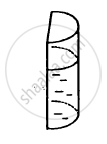
The surface tension of a liquid at critical temperature is ______
Two soap bubbles have a radius in the ratio of 2:3. Compare the works done in blowing these bubbles.
The wettability of a surface by a liquid depends primarily on
Define the angle of contact for a given pair of solid and liquid.
Distinguish between cohesive and adhesive forces.
What are the factors affecting the surface tension of a liquid?
Obtain an expression for the excess of pressure inside a
- liquid drop
- liquid bubble
- air bubble
A spherical soap bubble A of radius 2 cm is formed inside another bubble B of radius 4 cm. Show that the radius of a single soap bubble which maintains the same pressure difference as inside the smaller and outside the larger soap bubble is lesser than the radius of both soap bubbles A and B.
Surface tension is exhibited by liquids due to force of attraction between molecules of the liquid. The surface tension decreases with increase in temperature and vanishes at boiling point. Given that the latent heat of vaporisation for water Lv = 540 k cal kg–1, the mechanical equivalent of heat J = 4.2 J cal–1, density of water ρw = 103 kg l–1, Avagadro’s No NA = 6.0 × 1026 k mole–1 and the molecular weight of water MA = 18 kg for 1 k mole.
- Estimate the energy required for one molecule of water to evaporate.
- Show that the inter–molecular distance for water is `d = [M_A/N_A xx 1/ρ_w]^(1/3)` and find its value.
- 1 g of water in the vapor state at 1 atm occupies 1601 cm3. Estimate the intermolecular distance at boiling point, in the vapour state.
- During vaporisation a molecule overcomes a force F, assumed constant, to go from an inter-molecular distance d to d ′. Estimate the value of F.
- Calculate F/d, which is a measure of the surface tension.
We have three identical perfectly black plates. The temperatures of first and third plate is T and 3T. What is the temperature of second plate if system is in equilibrium?

The excess pressure inside a liquid drop is 500 Nm-2. If the radius of the drop is 2 mm, the surface tension of the liquid is x × 10-3 Nm-1. The value of x is ______.
