Advertisements
Advertisements
प्रश्न
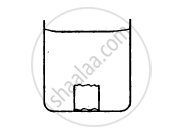
A metal piece of mass 160 g lies in equilibrium inside a glass of water. The piece touches the bottom of the glass at a small number of points. If the density of the metal is 8000 kg/m3, find the normal force exerted by the bottom of the glass on the metal piece.
Advertisements
उत्तर
Given:
Mass of the metal piece, m =160 gm = 160 × 10−3 kg
Density of the metal piece, ρm = 8000 kg/m3
Density of the water, ρw = 1000 kg/m3
Let R be the normal reaction and U be the upward thrust.
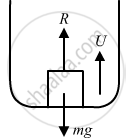
From the diagram, we have:
mg = U + R
⇒ R = mg −Vρwg [U = Vρwg]
\[\Rightarrow \text{R = mg }- \frac{\text{m}}{\rho_\text{m}} \times \rho_\text{w} \times \text{g}\]
\[= 160 \times {10}^{- 3} \times \left( 10 - \frac{{10}^3 \times 10}{8000} \right)\]
\[ = 160 \times {10}^{- 3} \times 10\left( 1 - \frac{1}{8} \right)\]
\[ = 1 . 4 \text{N }\]
APPEARS IN
संबंधित प्रश्न
The energy of the free surface of a liquid drop is 5π times the surface tension of the liquid. Find the diameter of the drop in C.G.S. system.
The surface tension of water at 0°C is 75.5 dyne/cm. Calculate surface tension of water at 25°C.
(α for water = 2.7×10⁻³/°C)
Derive an expression for excess pressure inside a drop of liquid.
The total free surface energy of a liquid drop is `pisqrt2` times the surface tension of the liquid. Calculate the diameter of the drop in S.l. unit.
When a sparingly soluble substance like alcohol is dissolved in water, surface tension of water
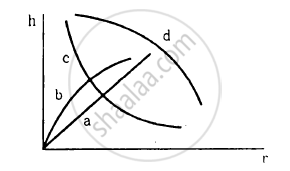
Which of the following graphs may represent the relation between the capillary rise hand the radius r of the capillary?
The rise of a liquid in a capillary tube depends on
(a) the material
(b) the length
(c) the outer radius
(d) the inner radius of the tube
The contact angle between a solid and a liquid is a property of
(a) the material of the solid
(b) the material of the liquid
(c) the shape of the solid
(d) the mass of the solid
The lower end of a capillary tube is immersed in mercury. The level of mercury in the tube is found to be 2 cm below the outer level. If the same tube is immersed in water, up to what height will the water rise in the capillary?
Find the surface energy of water kept in a cylindrical vessel of radius 6.0 cm. Surface tension of water = 0.075 J m−2.
Explain the capillary action.
Derive an expression for capillary rise for a liquid having a concave meniscus.
Twenty-seven droplets of water, each of radius 0.1 mm coalesce into a single drop. Find the change in surface energy. Surface tension of water is 0.072 N/m.
Obtain an expression for the capillary rise or fall using the forces method.
A certain number of spherical drops of a liquid of radius R coalesce to form a single drop of radius R and volume V. If T is the surface tension of the liquid, then
What is capillarity?
Two spherical rain drops reach the surface of the earth with terminal velocities having ratio 16 : 9. The ratio of their surface area is ______.
A large number of liquid drops each of radius 'r' coalesce to form a big drop of radius 'R'. The energy released in the process in converted into kinetic energy of the big drop. The speed of the big drop is ______. (T = surface tension of liquid, p = density of liquid)
Under isothermal conditions, two soap bubbles of radii 'r1' and 'r2' coalesce to form a big drop. The radius of the big drop is ______.
The surface tension of soap solution is 25 × 10-3 Nm-1. The excess of pressure inside a soap bubble of diameter 1 cm is ______.
