Advertisements
Advertisements
प्रश्न
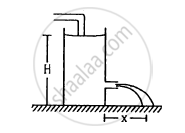
Water level is maintained in a cylindrical vessel up to a fixed height H. The vessel is kept on a horizontal plane. At what height above the bottom should a hole be made in the vessel so that the water stream coming out of the hole strikes the horizontal plane at the greatest distance from the vessel.
Advertisements
उत्तर
It is given that H is the height of the cylindrical vessel.
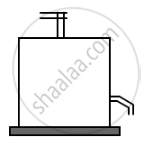
Now, let h be the height of the hole from the surface of the tank.
The velocity of water \[\left( v \right)\] is given by
\[v = \sqrt{2g(H - h)}\]
Also, let t be the time of flight.
Now,
\[t = \sqrt{\frac{2h}{g}}\]
Let x be the maximum horizontal distance .
\[ \therefore x = v \times t\]
\[ = \sqrt{2g(H - h)} \times \sqrt{\frac{2h}{g}}\]
\[ = \sqrt{4(Hh - h^2 )}\]
For x to be maximum,
\[\frac{d}{dh}\left( Hh - h^2 \right) = 0\]
\[ \Rightarrow 0 = H - 2h\]
\[ \Rightarrow h = \frac{H}{2}\]
APPEARS IN
संबंधित प्रश्न
A U-shaped wire is dipped in a soap solution and removed. The thin soap film formed between the wire and the light slider supports a weight of 1.5 × 10⁻² N (which includes the small weight of the slider). The length of the slider is 30 cm. What is the surface tension of the film?
The contact angle between pure water and pure silver is 90°. If a capillary tube made of silver is dipped at one end in pure water, will the water rise in the capillary?
A uniform vertical tube of circular cross section contains a liquid. The contact angle is 90°. Consider a diameter of the tube lying in the surface of the liquid. The surface to the right of this diameter pulls the surface on the left of it. What keeps the surface on the left in equilibrium?
The force of surface tension acts tangentially to the surface whereas the force due to air pressure acts perpendicularly on the surface. How is then the force due to excess pressure inside a bubble balanced by the force due to the surface tension?
A drop of mercury of radius 2 mm is split into 8 identical droplets. Find the increase in surface energy. Surface tension of mercury = 0.465 J m−2.
Two large glass plates are placed vertically and parallel to each other inside a tank of water with separation between the plates equal to 1 mm. Find the rise of water in the space between the plates. Surface tension of water = 0.075 Nm−1.
Solve the previous problem if the lead piece is fastened on the top surface of the block and the block is to float with its upper surface just dipping into water.
Why is the surface tension of paints and lubricating oils kept low?
Explain the capillary action.
Twenty-seven droplets of water, each of radius 0.1 mm coalesce into a single drop. Find the change in surface energy. Surface tension of water is 0.072 N/m.
Insect moves over the surface of water because of ______.
The water droplets are spherical in free fall due to ______
The surface tension of a liquid at critical temperature is ______
Explain the phenomena of surface tension on the basis of molecular theory.
Soap solution is used for cleaning dirty clothes because ______.
The free surface of oil in a tanker, at rest, is horizontal. If the tanker starts accelerating the free surface will be titled by an angle θ. If the acceleration is a ms–2, what will be the slope of the free surface?
Eight droplets of water each of radius 0.2 mm coalesce into a single drop. Find the decrease in the surface area.
A liquid flows out drop by drop from a vessel through a vertical tube with an internal diameter of 2 mm, then the total number of drops that flows out during 10 grams of the liquid flow out ______. [Assume that the diameter of the neck of a drop at the moment it breaks away is equal to the internal diameter of tube and surface tension is 0.02 N/m].
When an air bubble of radius r rises from the bottom to the surface of a lake, its radius becomes `(5r)/4`. Taking the atmospheric pressure to be equal to the 10 m height of the water column, the depth of the lake would approximately be ______.
(ignore the surface tension and the effect of temperature)
In most liquids, with the rise in temperature, the surface tension of a liquid ______.
