Advertisements
Advertisements
प्रश्न
Find the excess pressure inside (a) a drop of mercury of radius 2 mm (b) a soap bubble of radius 4 mm and (c) an air bubble of radius 4 mm formed inside a tank of water. Surface tension of mercury, soap solution and water are 0.465 N m−1, 0.03 N m−1 and 0.076 N m−1 respectively.
Advertisements
उत्तर
Given:
\[\text{ Radius of mercury drop r = 2 mm }= 2 \times {10}^{- 3} \text{ m }\]
\[\text{ Radius of soap bubble r = 4 mm }= 4 \times {10}^{- 3} \text{ m }\]
\[\text{ Radius of air bubble r = 4 mm } = 4 \times {10}^{- 3} \text{ m }\]
\[\text{ Surface tension of mercury T}_{Hg} = 0 . 465 \text{ N/m }\]
\[\text{ Surface tension of soap solution T}_s = 0 . 03 \text{ N/m }\]
\[\text{ Surface tension of water T}_a = 0 . 076 \text{ N/m}\]
(a) Excess pressure inside mercury drop:
\[P = \frac{2 T_{Hg}}{r}\]
\[ = \frac{0 . 465 \times 2}{2 \times {10}^{- 3}} = 465 \text{ N/ m}^2\]
(b) Excess pressure inside the soap bubble:
\[P = \frac{4 T_s}{r}\]
\[ = \frac{4 \times 0 . 03}{4 \times {10}^{- 3}} = 30 \text{ N/ m }^2 \]
(c) Excess pressure inside the air bubble:
\[P = \frac{2 T_a}{r}\]
\[ = \frac{2 \times 0 . 076}{4 \times {10}^{- 3}} = 38 \text{ N/ m}^2\]
APPEARS IN
संबंधित प्रश्न
The surface tension of water at 0ºc is 75·5 dyne/cm. Find surface tension of water at 25°C. [ α for water = 0·0021/°C ]
Water rises in a vertical capillary tube up to a length of 10 cm. If the tube is inclined at 45°, the length of water risen in the tube will be
The capillaries shown in figure have inner radii 0.5 mm, 1.0 mm and 1.5 mm respectively. The liquid in the beaker is water. Find the heights of water level in the capillaries. The surface tension of water is 7.5 × 10⁻² N m−1.
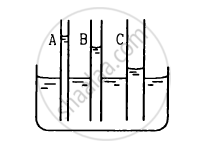
Find the surface energy of water kept in a cylindrical vessel of radius 6.0 cm. Surface tension of water = 0.075 J m−2.
A capillary tube of radius 1 mm is kept vertical with the lower end in water. (a) Find the height of water raised in the capillary. (b) If the length of the capillary tube is half the answer of part , find the angle θ made by the water surface in the capillary with the wall.
Two large glass plates are placed vertically and parallel to each other inside a tank of water with separation between the plates equal to 1 mm. Find the rise of water in the space between the plates. Surface tension of water = 0.075 Nm−1.
Insect moves over the surface of water because of ______.
A certain number of spherical drops of a liquid of radius R coalesce to form a single drop of radius R and volume V. If T is the surface tension of the liquid, then
What are the factors affecting the surface tension of a liquid?
The surface tension of the two liquids is respectively 20 and 60 dyne cm-1. The liquids drop from the ends of two tubes of the same radius. The ratio of the weights of the two drops is ______
A square frame of each side L is dipped in a soap solution and taken out. The force acting on the film formed is _____.
(T = surface tension of soap solution).
Water rises upto a height h in a capillary tube on the surface of the earth. The value of h will increase, if the experimental setup is kept in [g = acceleration due to gravity]
The wear and tear in the machine part is due to ______.
The angle of contact at the interface of water-glass is 0°, Ethylalcohol-glass is 0°, Mercury-glass is 140° and Methyliodide-glass is 30°. A glass capillary is put in a trough containing one of these four liquids. It is observed that the meniscus is convex. The liquid in the trough is ______.
Two narrow bores of diameter 5.0 mm and 8.0 mm are joined together to form a U-shaped tube open at both ends. If this U-tube contains water, what is the difference in the level of the two limbs, of the tube?
[Take surface tension of water T = 7.3 × 10⁻² Nm-1, angle of contact = 0, g = 10 ms-2 and density of water = 1.0 × 10³ kgm-3]
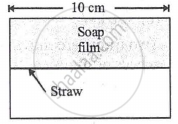
A soap film of surface tension 3 × 10⁻² formed in a rectangular frame can support a straw as shown in Fig. If g = 10 ms-12, the mass of the straw is ______.
When one end of the capillary is dipped in water, the height of water column is 'h'. The upward force of 105 dyne due to surface tension is balanced by the force due to the weight of water column. The inner circumference of capillary is ______.
(Surface tension of water = 7 × 10⁻² N/m)
A liquid drop of density ρ is floating half immersed in a liquid of density d. The diameter of the liquid drop is ______.
(ρ > d, g = acceleration due to gravity, T = surface tension)
Find the work done when a drop of mercury of radius 2 mm breaks into 8 equal droplets. [Surface tension of mercury = 0.4855 J/m2].
Define angle of contact.
