Advertisements
Advertisements
Question
Find the excess pressure inside (a) a drop of mercury of radius 2 mm (b) a soap bubble of radius 4 mm and (c) an air bubble of radius 4 mm formed inside a tank of water. Surface tension of mercury, soap solution and water are 0.465 N m−1, 0.03 N m−1 and 0.076 N m−1 respectively.
Advertisements
Solution
Given:
\[\text{ Radius of mercury drop r = 2 mm }= 2 \times {10}^{- 3} \text{ m }\]
\[\text{ Radius of soap bubble r = 4 mm }= 4 \times {10}^{- 3} \text{ m }\]
\[\text{ Radius of air bubble r = 4 mm } = 4 \times {10}^{- 3} \text{ m }\]
\[\text{ Surface tension of mercury T}_{Hg} = 0 . 465 \text{ N/m }\]
\[\text{ Surface tension of soap solution T}_s = 0 . 03 \text{ N/m }\]
\[\text{ Surface tension of water T}_a = 0 . 076 \text{ N/m}\]
(a) Excess pressure inside mercury drop:
\[P = \frac{2 T_{Hg}}{r}\]
\[ = \frac{0 . 465 \times 2}{2 \times {10}^{- 3}} = 465 \text{ N/ m}^2\]
(b) Excess pressure inside the soap bubble:
\[P = \frac{4 T_s}{r}\]
\[ = \frac{4 \times 0 . 03}{4 \times {10}^{- 3}} = 30 \text{ N/ m }^2 \]
(c) Excess pressure inside the air bubble:
\[P = \frac{2 T_a}{r}\]
\[ = \frac{2 \times 0 . 076}{4 \times {10}^{- 3}} = 38 \text{ N/ m}^2\]
APPEARS IN
RELATED QUESTIONS
A raindrop of diameter 4 mm is about to fall on the ground. Calculate the pressure inside the raindrop. [Surface tension of water T = 0.072 N/m, atmospheric pressure = 1.013 x 10⁵ N/m2 ]
Explain why Water with detergent dissolved in it should have small angles of contact.
Define surface tension and surface energy.
The force of surface tension acts tangentially to the surface whereas the force due to air pressure acts perpendicularly on the surface. How is then the force due to excess pressure inside a bubble balanced by the force due to the surface tension?
Viscosity is a property of
The properties of a surface are different from those of the bulk liquid because the surface molecules
(a) are smaller than other molecules
(b) acquire charge due to collision from air molecules
(c) find different type of molecules in their range of influence
(d) feel a net force in one direction.
A 5.0 cm long straight piece of thread is kept on the surface of water. Find the force with which the surface on one side of the thread pulls it. Surface tension of water = 0.076 N m−1.
Consider an ice cube of edge 1.0 cm kept in a gravity-free hall. Find the surface area of the water when the ice melts. Neglect the difference in densities of ice and water.
A hollow spherical body of inner and outer radii 6 cm and 8 cm respectively floats half-submerged in water. Find the density of the material of the sphere.
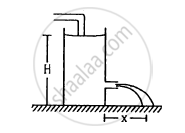
Water level is maintained in a cylindrical vessel up to a fixed height H. The vessel is kept on a horizontal plane. At what height above the bottom should a hole be made in the vessel so that the water stream coming out of the hole strikes the horizontal plane at the greatest distance from the vessel.
What are the factors affecting the surface tension of a liquid?
What do you mean by capillarity or capillary action?
A capillary of diameter d mm is dipped in water such that the water rises to a height of 30 mm. If the radius of the capillary is made `(2/3)` of its previous value, then compute the height up to which water will rise in the new capillary?
The surface tension of the two liquids is respectively 20 and 60 dyne cm-1. The liquids drop from the ends of two tubes of the same radius. The ratio of the weights of the two drops is ______
Under isothermal conditions, two soap bubbles of radii 'r1' and 'r2' coalesce to form a big drop. The radius of the big drop is ______.
The wear and tear in the machine part is due to ______.
We have three identical perfectly black plates. The temperatures of first and third plate is T and 3T. What is the temperature of second plate if system is in equilibrium?

When an air bubble of radius r rises from the bottom to the surface of a lake, its radius becomes `(5r)/4`. Taking the atmospheric pressure to be equal to the 10 m height of the water column, the depth of the lake would approximately be ______.
(ignore the surface tension and the effect of temperature)
The excess pressure inside a liquid drop is 500 Nm-2. If the radius of the drop is 2 mm, the surface tension of the liquid is x × 10-3 Nm-1. The value of x is ______.
The surface tension of a soap solution is T. The work done in blowing a soap bubble of diameter d to that of a diameter 2d is ______.
