Advertisements
Advertisements
Question
A capillary of diameter d mm is dipped in water such that the water rises to a height of 30 mm. If the radius of the capillary is made `(2/3)` of its previous value, then compute the height up to which water will rise in the new capillary?
Advertisements
Solution
Let diameter of capillary tube = d mm
Let the radius of capillary tube r1 = r mm
Capillary rise h1 = 30 mm
Let the radius of another capillary tube r2 = `2/3` r
Let the capillary rise of another capillary tube be h2
We know that
T = `("hr"ρ"g")/2`
∴ `"h" ∝ 1/"r"`
`"h"_1/"h"_2 = "r"_2/"r"_1`
`30/"h"_2 = (2/3 "r")/"r"`
`30/"h"_2 = 2/3`
∴ h2 = `(3 xx 30)/2` = 45 mm
Capillary rise in the new capillary tube = 45 mm
APPEARS IN
RELATED QUESTIONS
Water rises to a height 3.2 cm in a glass capillary tube. Find the height to which the same water will rise in another glass capillary having half area of cross section.
Explain why Water with detergent dissolved in it should have small angles of contact.
Mercury has an angle of contact equal to 140° with soda lime glass. A narrow tube of radius 1.00 mm made of this glass is dipped in a trough containing mercury. By what amount does the mercury dip down in the tube relative to the liquid surface outside? Surface tension of mercury at the temperature of the experiment is 0.465 N m–1. Density of mercury = 13.6 × 10³ kg m–3
If more air is pushed in a soap bubble, the pressure in it
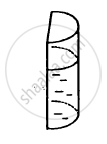
A liquid is contained in a vertical tube of semicircular cross section. The contact angle is zero. The force of surface tension on the curved part and on the flat part are in ratio
Find the surface energy of water kept in a cylindrical vessel of radius 6.0 cm. Surface tension of water = 0.075 J m−2.
Find the force exerted by the water on a 2 m2 plane surface of a large stone placed at the bottom of a sea 500 m deep. Does the force depend on the orientation of the surface?
Numerical Problem.
A stone weighs 500 N. Calculate the pressure exerted by it if it makes contact with a surface of area 25 cm2.
Water rises upto a height h in a capillary tube on the surface of the earth. The value of h will increase, if the experimental setup is kept in [g = acceleration due to gravity]
Two mercury droplets of radii 0.1 cm. and 0.2 cm. collapse into one single drop. What amount of energy is released? The surface tension of mercury T = 435.5 × 10⁻³ Nm–1.
