Advertisements
Advertisements
प्रश्न
Describe an experiment to prove that friction depends on the nature of a surface.
Advertisements
उत्तर
To understand the frictional force between the layers of liquid in motion.
- Materials required: Different kinds of liquid (coconut oil, honey, water, ghee), glass plates – 4 nos.
- Procedure:
a. Take a small number of different kinds of liquid like coconut oil, honey, water, and ghee, etc., in a cup.
b. Place one drop of each liquid on a separate glass plate.
c. Next, gently raise one end of the glass plate, one by one, so as to allow the liquid to slide down the smooth surface of the plate.
c. Observe the speed of each liquid. - Observation:
Each liquid moves at a different speed. Water flows faster than other liquids. Coconut oil flows at a moderate speed. Ghee flows very slowly. - Inference:
Between the layers of each liquid, in motion, there is a frictional force parallel to the layers of the liquid. This frictional force opposes the motion of the liquid layers while they are in motion.
APPEARS IN
संबंधित प्रश्न
A body weighs 4.0 kg-wt on the surface of the Earth. What will be its weight on the surface of a plant whose mass is `1/8` th of the mass of the Earth and radius half `(1/2)` of that of the Earth?
State any two characteristics of the angle of contact
The contact angle between pure water and pure silver is 90°. If a capillary tube made of silver is dipped at one end in pure water, will the water rise in the capillary?
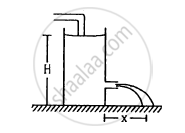
Water level is maintained in a cylindrical vessel up to a fixed height H. The vessel is kept on a horizontal plane. At what height above the bottom should a hole be made in the vessel so that the water stream coming out of the hole strikes the horizontal plane at the greatest distance from the vessel.
Insect moves over the surface of water because of ______.
What do you mean by capillarity or capillary action?
A spherical soap bubble A of radius 2 cm is formed inside another bubble B of radius 4 cm. Show that the radius of a single soap bubble which maintains the same pressure difference as inside the smaller and outside the larger soap bubble is lesser than the radius of both soap bubbles A and B.
Two spherical rain drops reach the surface of the earth with terminal velocities having ratio 16 : 9. The ratio of their surface area is ______.
Water rises upto a height h in a capillary tube on the surface of the earth. The value of h will increase, if the experimental setup is kept in [g = acceleration due to gravity]
Two blocks of masses m and M are connected by means of a metal wire of cross-sectional area A passing over a frictionless fixed pully as shown in the figure. The system is then released. If M = 2m, then the stress produced in the wire is ______.

