Advertisements
Advertisements
Question
A metal sphere of radius 1 mm and mass 50 mg falls vertically in glycerine. Find (a) the viscous force exerted by the glycerine on the sphere when the speed of the sphere is 1 cm s−1, (b) the hydrostatic force exerted by the glycerine on the sphere and (c) the terminal velocity with which the sphere will move down without acceleration. Density of glycerine = 1260 kg m−3 and its coefficient of viscosity at room temperature = 8.0 poise.
Advertisements
Solution
Given:
Radius of metallic sphere r = 1 mm = 10−3 m
Speed of the sphere v = 10−2 m/s
Coefficient of viscosity η = 8 poise = 0.8 decapoise
Mass m = 50 mg = 50 × 10−3 kg
Density of glycerin σ = 1260 kg/m3
(a) Viscous force exerted by glycerine on the sphere F = 6πηrv
⇒ F= 6 × (3.14) × (0.8) × 10−3 × (10−2)
= 1.50 × 10⁻⁴ N
(b) Let V be the volume of the sphere.
Hydrostatic force exerted by glycerin on the sphere
\[F' = V\sigma g\]
\[\Rightarrow F' = \frac{4}{3}\pi r^2 \sigma g\]
\[= \left( \frac{4}{3} \right) \times \left( 3 . 14 \right) \times \left( {10}^{- 6} \right) \times 1260 \times 10\]
\[ = 5 . 275 \times {10}^{- 5} \text{N}\]
(c) Let the terminal velocity of the sphere be v'.
The forces acting on the drops are
(i) The weight mg acting downwards
(ii) The force of buoyance, i.e., \[\frac{4}{3}\pi r^3 \sigma g\] acting upwards
(iii) The force of viscosity, i.e., 6πηrv' acting upwards
From the free body diagram:
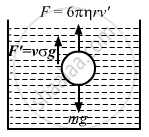
\[6\pi\eta r v' + \frac{4}{3}\pi r^3 \sigma g = \text{ mg}\]
\[ \Rightarrow v = \frac{\text{ mg }- \frac{4}{3}\pi r^2 \sigma g}{6\pi\eta r}\]
\[ = \frac{50 \times {10}^{- 3} - \frac{4}{3} \times 3 . 14 \times {10}^{- 6} \times 1260 \times 10}{6 \times 3 . 14 \times 0 . 8 \times {10}^{- 3}}\]
\[ = \frac{500 - \frac{4}{3} \times 3 . 14 \times {10}^{- 3} \times 1260 \times 10}{6 \times 3 . 14 \times 0 . 8}\]
\[ = 2 . 3 \text{ cm/s }\]
APPEARS IN
RELATED QUESTIONS
In Millikan’s oil drop experiment, what is the terminal speed of an uncharged drop of radius 2.0 × 10⁻⁵ m and density 1.2 × 10³ kg m–3? Take the viscosity of air at the temperature of the experiment to be 1.8 × 10⁻⁵ Pa s. How much is the viscous force on the drop at that speed? Neglect buoyancy of the drop due to air.
The force of viscosity is
Water flows at a speed of 6 cm s−1 through a tube of radius 1 cm. Coefficient of viscosity of water at room temperature is 0.01 poise. Calculate the Reynolds number. Is it a steady flow?
The unit of viscosity is
With an increase in temperature, the viscosity of liquid and gas, respectively will __________.
Distinguish between streamlined flow and turbulent flow.
Derive the expression for the terminal velocity of a sphere moving in a high viscous fluid using stokes force.
An incompressible liquid flows through a unifonn cross sectional tube with velocity 20 cm/s. If the thickness of liquid layer is 0.8 cm then velocity of gradient of flow is ____________.
Choose the CORRECT statement.
Analogy
Viscous force: ______:: Buoyant force: ______.
The velocity of a small ball of mass M and density d, when dropped in a container filled with glycerine becomes constant after some time. If the density of glycerine is `"d"/2` , then the viscous force acting on the ball will be ______.
Is viscosity a vector?
A solid ball of density ρ1 and radius r falls vertically through a liquid of density ρ2. Assume that the viscous force acting on the ball is F = krv, where k is a constant and v its velocity. What is the terminal velocity of the ball?
The coefficient of apparent expansion of mercury in a glass vessel is 153 × 10-6/°C and in a steel vessel is 144 × 10-6/°C. If α for steel is 12 × 10-6/°C, then that of glass is ______.
Define the coefficient of viscosity.
State and explain Newton's law of viscosity.
A water pipe with diameter of 5.0 cm is connected to another pipe of diameter 2.5 cm. How would the speeds of the water flow compare?
