Advertisements
Advertisements
Question
Derive the expression for the terminal velocity of a sphere moving in a high viscous fluid using stokes force.
Advertisements
Solution
Expression for terminal velocity: Consider a sphere of radius r which falls freely through a highly viscous liquid of coefficient of viscosity η. Let the density of the material of the sphere be ρ and the density of the fluid be σ.

Forces acting on the sphere when it falls in a viscous liquid
Gravitational force acting on the sphere,
FG = mg = `4/3π"r"^3ρ"g"` (downward force)
Upthrust, U = `4/3π"r"^3σ"g"` (upward force)
Viscous force, F = 6πηrvt
At terminal velocity vt,
Downward force = upward force
FG = U + F
FG − U = F ⇒ `4/3π"r"^3ρ"g" - 4/3π"r"^3σ"g"` = 6πηrvt
vt = `2/9 xx ("r"^2(ρ - σ))/η` g ⇒ `"v"_"t" ∝ "r"^2`
Here, it should be noted that the terminal speed of the sphere is directly proportional to the square of its radius. If a is greater than ρ, then the term (ρ – σ) becomes negative leading to a negative terminal velocity.
APPEARS IN
RELATED QUESTIONS
Fill in the blanks using the word(s) from the list appended with each statement
Viscosity of gases. .. with temperature, whereas viscosity of liquids . . . with temperature (increases / decreases)
The viscous force acting between two layers of a liquid is given by \[\frac{F}{A} = - \eta\frac{dv}{dz}\]. This F/A may be called
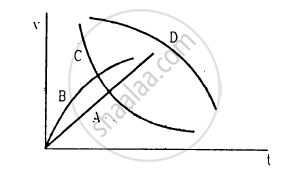
A spherical ball is dropped in a long column of a viscous liquid. The speed of the ball as a function of time may be best represented by the graph
With an increase in temperature, the viscosity of liquid and gas, respectively will __________.
Distinguish between streamlined flow and turbulent flow.
A small metal sphere of mass M and density d1, when dropped in a jar filled with liquid moves with terminal velocity after sometime. The viscous force acting on the sphere is (d2 = density of liquid and g = gravitational acceleration)
A solid ball of density ρ1 and radius r falls vertically through a liquid of density ρ2. Assume that the viscous force acting on the ball is F = krv, where k is a constant and v its velocity. What is the terminal velocity of the ball?
The velocity of a small ball of mass 0.3 g and density 8 g/cc when dropped in a container filled with glycerine becomes constant after some time. If the density of glycerine is 1.3 g/cc, then the value of viscous force acting on the ball will be x × 10-4 N, and the value of x is ______.
[use g = 10 m/s2]
The dimensions of coefficient of viscosity are ______.
A water pipe with diameter of 5.0 cm is connected to another pipe of diameter 2.5 cm. How would the speeds of the water flow compare?
