Advertisements
Advertisements
Question
In Millikan’s oil drop experiment, what is the terminal speed of an uncharged drop of radius 2.0 × 10⁻⁵ m and density 1.2 × 10³ kg m–3? Take the viscosity of air at the temperature of the experiment to be 1.8 × 10⁻⁵ Pa s. How much is the viscous force on the drop at that speed? Neglect buoyancy of the drop due to air.
Advertisements
Solution 1
Terminal speed = 5.8 cm/s; Viscous force = 3.9 × 10⁻¹⁰ N
Radius of the given uncharged drop, r = 2.0 × 10⁻⁵ m
Density of the uncharged drop, ρ = 1.2 × 10³ kg m–3
Viscosity of air, `eta = 1.8 xx 10^(-5) Pa s`
Density of air (`rho_0`) can be taken as zero in order to neglect buoyancy of air.
Acceleration due to gravity, g = 9.8 m/s2
Terminal velocity (v) is given by the relation:
`v = (2r^2 xx (rho - rho_0)g)/(9eta)`
`= (2xx(2.0xx10^(-5))^2 (1.2xx10^3 - 0)xx 9.8)/(9xx1.8xx10^(-5))`
`= 5.807 xx10^(-2) ms^(-1)`
`= 5.8 cm^1`
Hence, the terminal speed of the drop is 5.8 cm s–1.
The viscous force on the drop is given by:
`F = 6pietarv`
`:. F = 6xx3.14xx1.8xx10^(-5)xx2.0xx^(-5)xx 5.8xx10^(-2)`
`= 3.9 xx 10^(-10) N`
Hence, the viscous force on the drop is 3.9 × 10⁻¹⁰ N.
Solution 2
Here radius of drop, r = 2.0 x 10⁻⁵ m, density of drop, p = 1.2 x 10³ kg/m3, viscosity of air TI = 1.8 x 10⁻⁵Pa-s.
Neglecting upward thrust due to air, we find that terminal speed is
`v_r = 2/9 (r62rhog)/eta = (2xx(2.0xx10^(-5))^2xx(1.2xx10^3))xx9.8)/(9xx(1.8xx10^(-5)))`
`= 5.81 xx 10^(-2) ms^(-1) " or " 5.81 cm s^(-1)`
Viscous force at this speed
`F = 6pietarv = 6 xx 3.14 xx (1.8xx10^(-5))xx (2.0xx10^(-5))xx (5.81xx10^(-2))`
`= 3.94 xx 10^(10) N`
APPEARS IN
RELATED QUESTIONS
Explain why The size of the needle of a syringe controls flow rate better than the thumb pressure exerted by a doctor while administering an injection
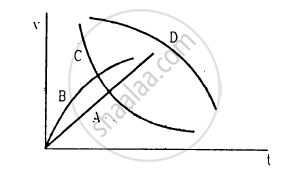
A spherical ball is dropped in a long column of a viscous liquid. The speed of the ball as a function of time may be best represented by the graph
A metal sphere of radius 1 mm and mass 50 mg falls vertically in glycerine. Find (a) the viscous force exerted by the glycerine on the sphere when the speed of the sphere is 1 cm s−1, (b) the hydrostatic force exerted by the glycerine on the sphere and (c) the terminal velocity with which the sphere will move down without acceleration. Density of glycerine = 1260 kg m−3 and its coefficient of viscosity at room temperature = 8.0 poise.
Water flows at a speed of 6 cm s−1 through a tube of radius 1 cm. Coefficient of viscosity of water at room temperature is 0.01 poise. Calculate the Reynolds number. Is it a steady flow?
With an increase in temperature, the viscosity of liquid and gas, respectively will __________.
Two streamlines cannot cross each other. Why?
A block of Ag of mass x kg hanging from a string is immersed in a liquid of relative density 0.72. If the relative density of Ag is 10 and tension in the string is 37.12 N then compute the mass of Ag block.
A small metal sphere of mass M and density d1, when dropped in a jar filled with liquid moves with terminal velocity after sometime. The viscous force acting on the sphere is (d2 = density of liquid and g = gravitational acceleration)
In motors, more viscous oil is used in summer than in winter due to ____________.
The velocity of water in river is 8 km/hr of the upper surface. The river is 12 m deep. If the coefficient of viscosity of water is 10-2 poise then the shearing stress between horizontal layers of water is ______.
The velocity of a small ball of mass M and density d, when dropped in a container filled with glycerine becomes constant after some time. If the density of glycerine is `"d"/2`, then the viscous force acting on the ball will be ______
With increase in temperature, the viscosity of ______.
- gases decreases.
- liquids increases.
- gases increases.
- liquids decreases.
Is viscosity a vector?
A solid ball of density ρ1 and radius r falls vertically through a liquid of density ρ2. Assume that the viscous force acting on the ball is F = krv, where k is a constant and v its velocity. What is the terminal velocity of the ball?
An air bubble of negligible weight having radius r rises steadily through a solution of density σ at speed v. The coefficient of viscosity of the solution is given by ______.
A spherical solid ball of volume V is made of a material of density ρ1. It is falling through a liquid of density ρ2 (ρ2 < ρ1). Assume that the liquid applies a viscous force on the ball that is proportional to the square of its speed v, i.e., `"F"_"viscous"`= -kv2 (k > 0). The terminal speed of the ball is ______.
State and explain Newton's law of viscosity.
A force of 0.01 N is required to move a flat glass plate of area of 10 cm2 with a uniform velocity of 1 cm/ s over the surface of a liquid 2 mm thick. If the coefficient of viscosity of the liquid is 20 poise, the velocity gradient in the liquid layer is ______.
The dimensions of coefficient of viscosity are ______.
