Advertisements
Advertisements
Question
The viscous force acting between two layers of a liquid is given by \[\frac{F}{A} = - \eta\frac{dv}{dz}\]. This F/A may be called
Options
pressure
longitudinal stress
tangential stress
volume stress
Advertisements
Solution
The viscous force acts tangentially between two parallel layers of a liquid. In terms of force on a material, it is analogous to a shearing force.
APPEARS IN
RELATED QUESTIONS
Fill in the blanks using the word(s) from the list appended with each statement
For solids with elastic modulus of rigidity, the shearing force is proportional to . . . , while for fluids it is proportional to . .. (shear strain / rate of shear strain)
(a) What is the largest average velocity of blood flow in an artery of radius 2 × 10⁻³ m if the flow must remain laminar? (b) What is the corresponding flow rate? (Take viscosity of blood to be 2.084 × 10⁻³ Pa s).
The force of viscosity is
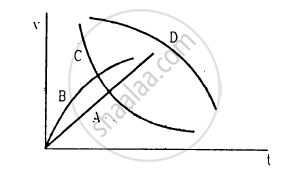
A spherical ball is dropped in a long column of a viscous liquid. The speed of the ball as a function of time may be best represented by the graph
A metal sphere of radius 1 mm and mass 50 mg falls vertically in glycerine. Find (a) the viscous force exerted by the glycerine on the sphere when the speed of the sphere is 1 cm s−1, (b) the hydrostatic force exerted by the glycerine on the sphere and (c) the terminal velocity with which the sphere will move down without acceleration. Density of glycerine = 1260 kg m−3 and its coefficient of viscosity at room temperature = 8.0 poise.
Define terminal velocity.
Derive the expression for the terminal velocity of a sphere moving in a high viscous fluid using stokes force.
Derive Poiseuille’s formula for the volume of a liquid flowing per second through a pipe under streamlined flow.
The tangential force or viscous drag on any layer of the liquid is directly proportional to the velocity gradient `"dv"/"dx"`. Then the direction of dx velocity gradient is ____________.
Clouds float in the air due to ______.
The velocity of a small ball of mass M and density d, when dropped in a container filled with glycerine becomes constant after some time. If the density of glycerine is `"d"/2` , then the viscous force acting on the ball will be ______.
A solid ball of density ρ1 and radius r falls vertically through a liquid of density ρ2. Assume that the viscous force acting on the ball is F = krv, where k is a constant and v its velocity. What is the terminal velocity of the ball?
The coefficient of apparent expansion of mercury in a glass vessel is 153 × 10-6/°C and in a steel vessel is 144 × 10-6/°C. If α for steel is 12 × 10-6/°C, then that of glass is ______.
A liquid of density ρ and coefficient of viscosity η flows with velocity v through a tube of diameter D. A quantity `"R" = (rho"vD")/η`, determines whether the flow will be streamlined or turbulent. R has the dimension of ______.
An incompressible liquid is flowing through a uniform cross-sectional tube with a velocity 12 cm/ s. If the thickness of liquid layer is 0.8 cm, what is the velocity gradient of that flow of liquid?
A force of 0.01 N is required to move a flat glass plate of area of 10 cm2 with a uniform velocity of 1 cm/ s over the surface of a liquid 2 mm thick. If the coefficient of viscosity of the liquid is 20 poise, the velocity gradient in the liquid layer is ______.
The dimensions of coefficient of viscosity are ______.
A water pipe with diameter of 5.0 cm is connected to another pipe of diameter 2.5 cm. How would the speeds of the water flow compare?
