Advertisements
Advertisements
प्रश्न
The viscous force acting between two layers of a liquid is given by \[\frac{F}{A} = - \eta\frac{dv}{dz}\]. This F/A may be called
विकल्प
pressure
longitudinal stress
tangential stress
volume stress
Advertisements
उत्तर
The viscous force acts tangentially between two parallel layers of a liquid. In terms of force on a material, it is analogous to a shearing force.
APPEARS IN
संबंधित प्रश्न
Fill in the blanks using the word(s) from the list appended with each statement
Viscosity of gases. .. with temperature, whereas viscosity of liquids . . . with temperature (increases / decreases)
In Millikan’s oil drop experiment, what is the terminal speed of an uncharged drop of radius 2.0 × 10⁻⁵ m and density 1.2 × 10³ kg m–3? Take the viscosity of air at the temperature of the experiment to be 1.8 × 10⁻⁵ Pa s. How much is the viscous force on the drop at that speed? Neglect buoyancy of the drop due to air.
The force of viscosity is
A raindrop falls near the surface of the earth with almost uniform velocity because
A spherical ball is dropped in a long column of a viscous liquid. The speed of the ball as a function of time may be best represented by the graph
A metal sphere of radius 1 mm and mass 50 mg falls vertically in glycerine. Find (a) the viscous force exerted by the glycerine on the sphere when the speed of the sphere is 1 cm s−1, (b) the hydrostatic force exerted by the glycerine on the sphere and (c) the terminal velocity with which the sphere will move down without acceleration. Density of glycerine = 1260 kg m−3 and its coefficient of viscosity at room temperature = 8.0 poise.
Estimate the speed of vertically falling raindrops from the following data. Radius of the drops = 0.02 cm, viscosity of air = 1.8 × 10⁻⁴ poise, g= 9.9 × 10 ms−2 and density of water = 1000 kg m−3.
Which has greater viscosity, oil or honey? Why?
Define the coefficient of viscosity of a liquid.
A small metal sphere of mass M and density d1, when dropped in a jar filled with liquid moves with terminal velocity after sometime. The viscous force acting on the sphere is (d2 = density of liquid and g = gravitational acceleration)
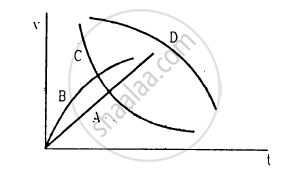
From amongst the following curves, which one shows the variation of the velocity v with time t for a small-sized spherical body falling vertically in a long column of a viscous liquid.
Analogy
Viscous force: ______:: Buoyant force: ______.
With increase in temperature, the viscosity of ______.
- gases decreases.
- liquids increases.
- gases increases.
- liquids decreases.
An air bubble of negligible weight having radius r rises steadily through a solution of density σ at speed v. The coefficient of viscosity of the solution is given by ______.
Define the coefficient of viscosity.
Define velocity gradient.
An incompressible liquid is flowing through a uniform cross-sectional tube with a velocity 12 cm/ s. If the thickness of liquid layer is 0.8 cm, what is the velocity gradient of that flow of liquid?
The dimensions of coefficient of viscosity are ______.
A water pipe with diameter of 5.0 cm is connected to another pipe of diameter 2.5 cm. How would the speeds of the water flow compare?
