Advertisements
Advertisements
प्रश्न
A raindrop falls near the surface of the earth with almost uniform velocity because
विकल्प
its weight is negligible
the force of surface tension balances its weight
the force of viscosity of air balance its weight
the drops are charged and atmospheric electric field balances its weight.
Advertisements
उत्तर
Air has viscosity. During rainfall, the raindrops acquire acceleration due to gravity. However, the increase in velocity is hindered by the viscous force acting upwards. A gradual balance between the two opposing forces causes the raindrops to attain a terminal velocity, thus, falling with a uniform velocity.
APPEARS IN
संबंधित प्रश्न
(a) What is the largest average velocity of blood flow in an artery of radius 2 × 10⁻³ m if the flow must remain laminar? (b) What is the corresponding flow rate? (Take viscosity of blood to be 2.084 × 10⁻³ Pa s).
The force of viscosity is
A spherical ball is dropped in a long column of a viscous liquid. The speed of the ball as a function of time may be best represented by the graph
Estimate the speed of vertically falling raindrops from the following data. Radius of the drops = 0.02 cm, viscosity of air = 1.8 × 10⁻⁴ poise, g= 9.9 × 10 ms−2 and density of water = 1000 kg m−3.
Water flows at a speed of 6 cm s−1 through a tube of radius 1 cm. Coefficient of viscosity of water at room temperature is 0.01 poise. Calculate the Reynolds number. Is it a steady flow?
A small sphere of radius 2 cm falls from rest in a viscous liquid. Heat is produced due to viscous force. The rate of production of heat when the sphere attains its terminal velocity is proportional to
Distinguish between streamlined flow and turbulent flow.
What is Reynold’s number? Give its significance.
Define terminal velocity.
Two streamlines cannot cross each other. Why?
Derive the expression for the terminal velocity of a sphere moving in a high viscous fluid using stokes force.
Why two holes are made to empty an oil tin?
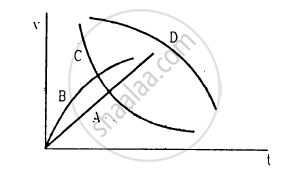
From amongst the following curves, which one shows the variation of the velocity v with time t for a small-sized spherical body falling vertically in a long column of a viscous liquid.
Analogy
Viscous force: ______:: Buoyant force: ______.
Clouds float in the air due to ______.
A spherical solid ball of volume V is made of a material of density ρ1. It is falling through a liquid of density ρ2 (ρ2 < ρ1). Assume that the liquid applies a viscous force on the ball that is proportional to the square of its speed v, i.e., `"F"_"viscous"`= -kv2 (k > 0). The terminal speed of the ball is ______.
A liquid of density ρ and coefficient of viscosity η flows with velocity v through a tube of diameter D. A quantity `"R" = (rho"vD")/η`, determines whether the flow will be streamlined or turbulent. R has the dimension of ______.
Define the coefficient of viscosity.
State the formula and S.I. units of coefficient of viscosity.
A force of 0.01 N is required to move a flat glass plate of area of 10 cm2 with a uniform velocity of 1 cm/ s over the surface of a liquid 2 mm thick. If the coefficient of viscosity of the liquid is 20 poise, the velocity gradient in the liquid layer is ______.
