Advertisements
Advertisements
प्रश्न
The force of viscosity is
विकल्प
electromagnetic
gravitational
nuclear
weak
Advertisements
उत्तर
The force of viscosity arises from molecular interaction between different layers of fluids that are in motion. Molecular forces are electromagnetic in nature. Therefore, viscosity must also be electromagnetic.
APPEARS IN
संबंधित प्रश्न
Fill in the blanks using the word(s) from the list appended with each statement
Viscosity of gases. .. with temperature, whereas viscosity of liquids . . . with temperature (increases / decreases)
A raindrop falls near the surface of the earth with almost uniform velocity because
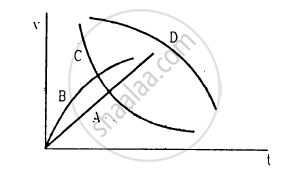
A spherical ball is dropped in a long column of a viscous liquid. The speed of the ball as a function of time may be best represented by the graph
The unit of viscosity is
In a horizontal pipe of non-uniform cross-section, water flows with a velocity of 1 ms−1 at a point where the diameter of the pipe is 20 cm. The velocity of water (1.5 ms−1) at a point where the diameter of the pipe is (in cm)
Write down the expression for Stoke’s force and explain the symbols involved in it.
Why two holes are made to empty an oil tin?
An incompressible liquid flows through a unifonn cross sectional tube with velocity 20 cm/s. If the thickness of liquid layer is 0.8 cm then velocity of gradient of flow is ____________.
From amongst the following curves, which one shows the variation of the velocity v with time t for a small-sized spherical body falling vertically in a long column of a viscous liquid.
The tangential force or viscous drag on any layer of the liquid is directly proportional to the velocity gradient `"dv"/"dx"`. Then the direction of dx velocity gradient is ____________.
The velocity of water in river is 8 km/hr of the upper surface. The river is 12 m deep. If the coefficient of viscosity of water is 10-2 poise then the shearing stress between horizontal layers of water is ______.
Analogy
Viscous force: ______:: Buoyant force: ______.
With increase in temperature, the viscosity of ______.
- gases decreases.
- liquids increases.
- gases increases.
- liquids decreases.
A solid ball of density ρ1 and radius r falls vertically through a liquid of density ρ2. Assume that the viscous force acting on the ball is F = krv, where k is a constant and v its velocity. What is the terminal velocity of the ball?
The velocity of a small ball of mass 0.3 g and density 8 g/cc when dropped in a container filled with glycerine becomes constant after some time. If the density of glycerine is 1.3 g/cc, then the value of viscous force acting on the ball will be x × 10-4 N, and the value of x is ______.
[use g = 10 m/s2]
Define the coefficient of viscosity.
Define velocity gradient.
An incompressible liquid is flowing through a uniform cross-sectional tube with a velocity 12 cm/ s. If the thickness of liquid layer is 0.8 cm, what is the velocity gradient of that flow of liquid?
