Advertisements
Advertisements
प्रश्न
Fill in the blanks using the word(s) from the list appended with each statement
Viscosity of gases. .. with temperature, whereas viscosity of liquids . . . with temperature (increases / decreases)
Advertisements
उत्तर
increases; decreases
Most fluids offer resistance to their motion. This is like internal mechanical friction, known as viscosity. Viscosity of gases increases with temperature, while viscosity of liquids decreases with temperature
APPEARS IN
संबंधित प्रश्न
(a) What is the largest average velocity of blood flow in an artery of radius 2 × 10⁻³ m if the flow must remain laminar? (b) What is the corresponding flow rate? (Take viscosity of blood to be 2.084 × 10⁻³ Pa s).
A raindrop falls near the surface of the earth with almost uniform velocity because
A spherical ball is dropped in a long column of a viscous liquid. The speed of the ball as a function of time may be best represented by the graph
A metal sphere of radius 1 mm and mass 50 mg falls vertically in glycerine. Find (a) the viscous force exerted by the glycerine on the sphere when the speed of the sphere is 1 cm s−1, (b) the hydrostatic force exerted by the glycerine on the sphere and (c) the terminal velocity with which the sphere will move down without acceleration. Density of glycerine = 1260 kg m−3 and its coefficient of viscosity at room temperature = 8.0 poise.
Which has greater viscosity, oil or honey? Why?
Define the coefficient of viscosity of a liquid.
What is Reynold’s number? Give its significance.
Two streamlines cannot cross each other. Why?
A small metal sphere of mass M and density d1, when dropped in a jar filled with liquid moves with terminal velocity after sometime. The viscous force acting on the sphere is (d2 = density of liquid and g = gravitational acceleration)
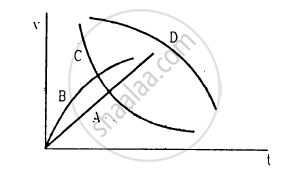
From amongst the following curves, which one shows the variation of the velocity v with time t for a small-sized spherical body falling vertically in a long column of a viscous liquid.
In motors, more viscous oil is used in summer than in winter due to ____________.
Analogy
Viscous force: ______:: Buoyant force: ______.
Clouds float in the air due to ______.
Is viscosity a vector?
A solid ball of density ρ1 and radius r falls vertically through a liquid of density ρ2. Assume that the viscous force acting on the ball is F = krv, where k is a constant and v its velocity. What is the terminal velocity of the ball?
Define velocity gradient.
State and explain Newton's law of viscosity.
